Some cameras are tools. Others are legendary drops — rare, coveted pieces of gear that reshape how you think about an entire discipline. The Contax G2 is firmly in the second category. Released in 1996 by Contax under the Kyocera umbrella and developed in close partnership with Carl Zeiss, this autofocus G-mount 35mm hybrid rangefinder camera didn’t just compete with the reigning kings of the film world — it challenged them on their own turf, armed with a roster of Zeiss lenses that photographers and collectors still consider among the finest glass ever mounted on a 35mm body. If you’ve been grinding through the film photography scene and you’re ready to level up your loadout, the Contax G2 deserves a permanent spot on your tier list. This is a camera that earns a locked-in 9.3/10 overall score — not because it’s flawless (nothing in photography truly is), but because in nearly every category that matters, it performs at an elite level that few cameras, analogue or digital, have ever matched. The specs are exceptional, the glass is S-tier, and the used-market ecosystem is deep enough that assembling your ideal G2 build is genuinely achievable right now.
🎮 The G2 Meta: Top 5 Most Popular Builds to Buy Right Now
Before we dive deep into the stat sheet, here’s a quick rundown of the five most popular Contax G2 configurations currently available on the used market. Whether you’re going body-only to pair with a single prime or chasing the full endgame loadout, there’s a build here for every shooter and every budget.
1. Contax G2 Body Only — Titanium (Champagne)

⭐⭐⭐⭐⭐ Rating: 9.5 / 10
The purest entry point into the G2 system. The titanium champagne body is the iconic look of this camera — sleek, compact at 140 × 81 × 46 mm, and weighing just 560g with the kind of build quality that makes modern plastic camera bodies feel like toys by comparison. It integrates the passive rangefinder-style autofocus system with an active AF module for pinpoint accuracy in mixed lighting conditions. The shutter is a vertical metal focal plane unit spanning an impressive 4 seconds all the way to 1/4000s, plus Bulb mode, and the camera shoots at a continuous 4 fps thanks to its built-in motor drive. With an ISO range of 6–6400, it handles everything from golden-hour portraits on Fuji Velvia to available-light documentary on pushed Ilford HP5. The single CR2 battery keeps the entire electronic system running reliably. For buyers who already own G-mount glass or want to start with a single prime, this is the cleanest, most flexible entry into the system.
Price Range: $1,615 – $2,300 USD (used market)
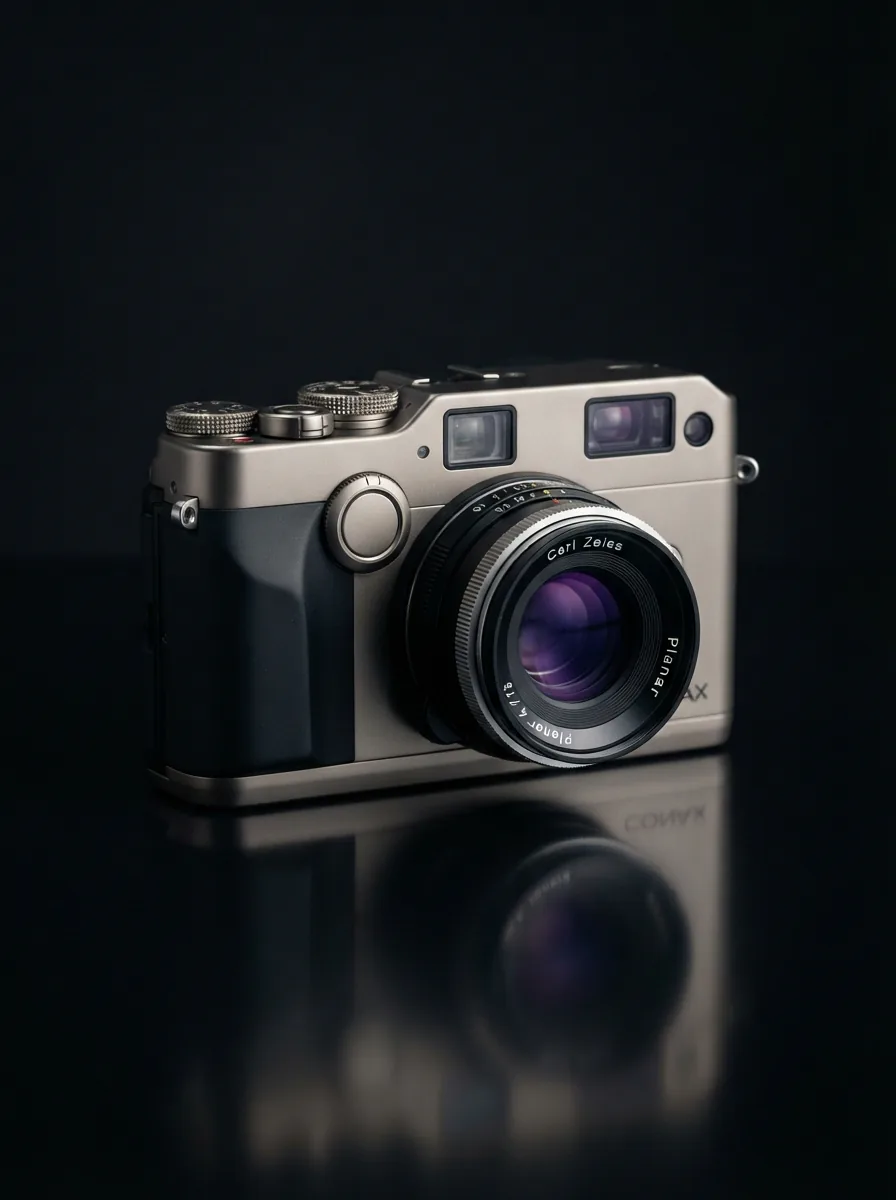
2. Contax G2 + Carl Zeiss Planar T* 45mm f/2

⭐⭐⭐⭐⭐ Rating: 9.7 / 10
This is the meta-defining combo — arguably the single best pairing across the entire G system and one of the most celebrated film camera configurations of the analogue era. The 45mm f/2 Planar T* is widely considered the crown jewel of the Contax G lens lineup: razor-sharp from wide open, with a natural field of view that mirrors the human eye, and a three-dimensional rendering quality that has earned it genuine cult status among film shooters worldwide. Reviewer Steve Huff, after testing the full G lens lineup, called the 45mm “probably the best of the bunch” — high praise from a photographer who regularly shoots with Leica glass. The Planar’s ability to separate subjects from backgrounds at f/2 with organic, film-native bokeh makes it the go-to lens for portraits, travel, and everyday street photography. On the used market, this pairing consistently commands attention and moves at a premium, a reliable indicator of how much the market values it.
Price Range: $2,299 – $2,800 USD (used market)
3. Contax G2 + Carl Zeiss Biogon T* 28mm f/2.8

⭐⭐⭐⭐½ Rating: 9.3 / 10
For the street photographer who wants edge-to-edge optical precision and a wider perspective for environmental storytelling, the Biogon 28mm f/2.8 is the power pick. This lens delivers the kind of clinical sharpness and minimal distortion you’d expect from a Zeiss symmetrical optical design, with exceptional contrast across the entire frame from wide open. The G2 body’s hybrid autofocus system shines particularly well with the 28mm — locking focus confidently even in variable light conditions and making the whole rig an ideal tool for fast-moving, unpredictable shooting environments where manual focus cameras demand too much deliberation. The Biogon 28mm is among the most frequently listed Contax G lenses on the used market, and near-mint examples regularly appear alongside G2 bodies as one of the platform’s most popular combinations.
Price Range: $1,999 – $2,800 USD (used market)
4. Contax G2 Three-Lens Kit (28mm + 45mm + 90mm)

⭐⭐⭐⭐⭐ Rating: 9.8 / 10
This is the endgame loadout — the full triple-prime setup that covers wide, standard, and short telephoto in one compact, featherweight travel package. The Biogon 28mm f/2.8, Planar 45mm f/2, and Sonnar 90mm f/2.8 form a trio that photographers have used across decades to cover weddings, editorial assignments, documentary projects, and travel photography with an ease that larger SLR systems simply can’t match in terms of portability. The system’s genius lies in the physical compactness of each lens: the complete three-prime set fits in a small shoulder bag alongside the G2 body, making it a genuine alternative to far bulkier SLR rigs. On eBay, near-mint three-lens kits frequently appear with the optional TLA200 flash included and move quickly — a consistent signal of how aggressively the market values this complete system configuration.
Price Range: $2,799 – $4,199 USD (used market)
5. Contax G2 Black Edition Body

⭐⭐⭐⭐⭐ Rating: 9.6 / 10
The black Contax G2 is the rare variant — a collector’s grail that commands a significant premium over the standard titanium model. With only around 29 black-finish examples listed among 171+ eBay listings at any given time (compared to 130 silver/titanium), finding one in excellent or near-mint condition is a genuine achievement unlock. Aesthetically it is striking: the all-black finish gives the G2 a stealthy, purposeful character that pairs brilliantly with the black versions of the G-mount Zeiss lenses, creating a cohesive, almost tactical look. For collectors and working photographers who want a camera that appreciates as an investment while functioning as a precision imaging tool, the black G2 is unambiguously the highest-tier drop available in the system.
Price Range: $2,349 – $9,999 USD (used market, body only to full kit)
🕹️ Origin Story: What Is the Contax G2 and Where Did It Come From?
To understand why the Contax G2 still generates excitement and commands premium prices decades after production ended, you need to understand the world it was born into. In 1994, Contax released the G1 — a compact autofocus rangefinder that broke the mold of what a 35mm camera in that form factor could achieve. Two years later, in 1996, the G2 arrived as the definitive revision, engineering a meaningful upgrade over the G1 by adding an active autofocus system alongside the passive rangefinder-style focusing the G1 had introduced. This dual autofocus architecture was a serious engineering achievement for a film camera of this size and weight, and it gave the G2 a focus reliability advantage over its predecessor that manifested clearly in the field.
The G2 was positioned explicitly as a direct competitor to the Leica M6, the undisputed king of 35mm rangefinder photography at the time. While it never fully displaced the Leica M in the hearts of purists — a distinction we’ll address in detail later — it offered something the M6 categorically could not: autofocus, motorized film advance and rewind, and a dramatically lower barrier of entry into the world of Carl Zeiss optics. Kamerastore currently prices certified G2 examples at $1,852 USD — a figure that reflects both the camera’s enduring desirability and the shrinking supply of well-maintained bodies now that production has permanently ceased.
🔧 Full Stat Sheet: Technical Specifications Breakdown
Every serious buyer needs the numbers before committing to any major camera purchase, and the Contax G2’s specification list reads impressively even by modern standards.
The vertical metal focal plane shutter operates across a range from 4 seconds to 1/4000s, with Bulb mode rounding out the available options. The 1/4000s ceiling is a meaningful differentiator from many rangefinder competitors — it means you can shoot the fastest Zeiss primes wide open in bright daylight without reaching for a neutral density filter, which is a practical limitation that film Leica M users regularly have to work around in outdoor conditions. The flash sync speed of 1/250s or faster enables clean fill-flash use in a wide variety of mixed-light scenarios.
The ISO range of 6–6400 is remarkably wide for a film camera of this era, accommodating virtually any film stock from the slowest Fuji Velvia 50 to pushed ISO 3200 and beyond. The camera reads DX-coded film cartridges automatically but allows manual override. Exposure compensation of ±2 EVs gives creative shooters meaningful control over the metered output without fully surrendering to the automatic program modes.
Physically, the G2 achieves a genuinely impressive balance: 140 × 81 × 46 mm at 560g. That form factor is large enough to feel substantial and well-balanced in the hand, yet small enough to carry in a coat pocket or a small bag for full-day sessions without physical fatigue. The titanium body construction contributes both to the low weight and to the camera’s well-documented durability — G2 bodies that have been properly maintained continue to function perfectly after decades of use, a testament to Kyocera’s manufacturing standards.
🎯 Autofocus: The Defining Boss-Fight Feature
The hybrid autofocus system is unquestionably the Contax G2’s signature stat — the feature that defines its competitive identity and most clearly separates it from every other rangefinder-style camera of its generation.
The passive AF system reads contrast and phase information from the scene to calculate focus distance without any emitted signal, working quickly and silently in good light conditions. The active AF system supplements it by projecting an infrared beam when passive contrast detection is insufficient — in low-contrast subjects, low light, or situations where passive systems would hunt and miss. The combination works with a reliability and speed that photographers accustomed to manual focus rangefinders often find startling on first use.
In practical shooting, focus acquisition is fast, accurate, and far less demanding than the manual patch-coincidence system used on Leica M cameras. For photographers who want to prioritize capturing decisive moments over technical focus ritual, the G2’s autofocus is a genuine quality-of-life upgrade. A scroll wheel on the camera’s front also provides manual focus override for situations demanding precise distance control, though it operates the lens motor electronically rather than mechanically coupling to the glass.
The well-documented trade-off is operational noise. The AF motor in G-mount lenses is audible — when the camera pre-focuses, the lens produces a mechanical sound that has been compared to a small servo or, in Steve Huff’s memorable phrasing, something resembling “robocop entering the room.” For outdoor shooting, street photography in busy environments, or travel work, this is barely noticeable. For photographers working in silent or intimate settings — churches, theaters, gallery openings — it is a meaningful limitation that favors a Leica or other manual system.
🔭 The Carl Zeiss Lens Ecosystem: Certified S-Tier Glass
If the autofocus system is the G2’s signature feature, the Carl Zeiss G-mount lens lineup is the legendary drop — the reason photographers continue to pay significant premiums for this system long after its production ended and the Contax brand ceased operations.
The G-mount system was built around a set of optically exceptional prime lenses covering focal lengths from 16mm to 90mm. The Hologon 16mm f/8 is a fixed-aperture ultra-wide that ships with its own dedicated viewfinder, serving extreme wide-angle specialists. The Biogon 28mm f/2.8 is a masterclass in wide-angle optical design, delivering flat, distortion-controlled rendering ideal for architecture, interiors, and documentary work. The Planar 35mm f/2 renders with a character that reviewers have compared to classic pre-ASPH Leica Summicron glass — subjects are sharp, backgrounds transition smoothly into pleasing blur, and the overall aesthetic has the timeless, organic quality that defines the best film-era Zeiss designs. The Planar 45mm f/2 remains the crown jewel of the system, offering corner-to-corner sharpness from wide open alongside the three-dimensional depth rendering and natural color response that Zeiss glass is globally celebrated for. The Sonnar 90mm f/2.8 completes the essential three-lens kit, delivering elegant subject separation and classic Zeiss micro-contrast. The Vario-Sonnar 35–70mm f/3.5–5.6 zoom rounds out the lineup as a versatile if less-celebrated option for photographers who prefer zoom flexibility.
What unifies all of these lenses is the Zeiss T* multi-layer anti-reflection coating — a treatment that reduces flare and internal reflections while elevating the color richness, contrast, and that distinctive Zeiss “pop” that digital post-processing workflows have spent decades attempting to replicate. Shooting Kodak Portra 400 through any of these lenses produces results with a dimensionality and tonal richness that serves as a strong argument for film photography in any era.
⚖️ Contax G2 vs. Leica M6: The Classic Rivalry That Defined an Era
No conversation about the G2 is complete without addressing the Leica M6 rivalry directly. These two cameras were the dominant competitors in premium 35mm rangefinder photography throughout the late 1990s, and the comparison remains immediately relevant today because both hold strong positions on the used market and both command serious collector and shooter interest.
The Leica M6 is the purist’s choice: a fully manual camera with a bright, high-magnification rangefinder viewfinder that delivers a focusing experience widely regarded as the finest in 35mm photography. It is near-silent in operation. It demands deliberate engagement with every exposure decision. It is, by design, a slow and meditative tool that builds a deep connection between photographer and subject.
The Contax G2 is the optimizer’s choice: faster to use in practical conditions, easier to operate across variable lighting situations, equipped with autofocus and automated film handling, and paired with a lens system that matches Leica glass on raw optical quality while frequently costing significantly less. As Steve Huff observed in his hands-on comparison, a complete G2 kit with three Zeiss primes can be assembled for roughly the same cost as a Leica M6 body alone — a value proposition that is genuinely difficult to argue against on optical merit.
The honest verdict: if you want the true rangefinder experience — the bright frameline window, the tactile manual focus ritual, the near-total silence — the G2 does not deliver it. The viewfinder is functional rather than inspiring, smaller and dimmer than the M6’s optics. If you want optical performance, autofocus convenience, and extraordinary value for the quality of glass you’re getting, the G2 wins the matchup convincingly and makes film photography accessible to a far wider range of photographers who might otherwise find the Leica experience too demanding or too expensive.
🏆 Final Verdict: Score Breakdown
The Contax G2 earns its legendary status through a combination of engineering intelligence, optical excellence, and enduring market desirability that few cameras of any format or era can match. It remains ranked #4 in Rangefinder Film Cameras on Amazon and continues to attract 170+ active listings on eBay at any given time — numbers that speak to both the depth of available inventory and the sustained demand that keeps prices elevated years after the last unit rolled off the production line.
| Category | Score |
|---|---|
| Build Quality | 9 / 10 |
| Autofocus Performance | 9 / 10 |
| Lens Ecosystem | 10 / 10 |
| Shooting Experience | 8.5 / 10 |
| Value for Money | 9.5 / 10 |
| Collector Appeal | 9 / 10 |
| Overall | 9.3 / 10 |
The G2 is not the camera for the purist who craves the meditative silence and deliberate, tactile ritual of a Leica M. It is the camera for the photographer who wants to shoot fast, shoot sharp, and shoot with some of the finest lenses ever mounted on a 35mm body — without taking out a second mortgage in the process. Whether you’re starting with a titanium body only, hunting the rare black edition for your collection, or assembling the full three-prime endgame loadout with 28mm, 45mm, and 90mm Zeiss glass, the G2 rewards every level of investment with results that are hard to argue with.
Load a roll of Kodak Portra 400, mount the Planar 45mm f/2, and shoot. The results will tell you everything you need to know about why this camera, nearly three decades after its release, remains one of the most beloved pieces of film photography hardware ever made.
Achievement unlocked: Contax G2 — Acquired.