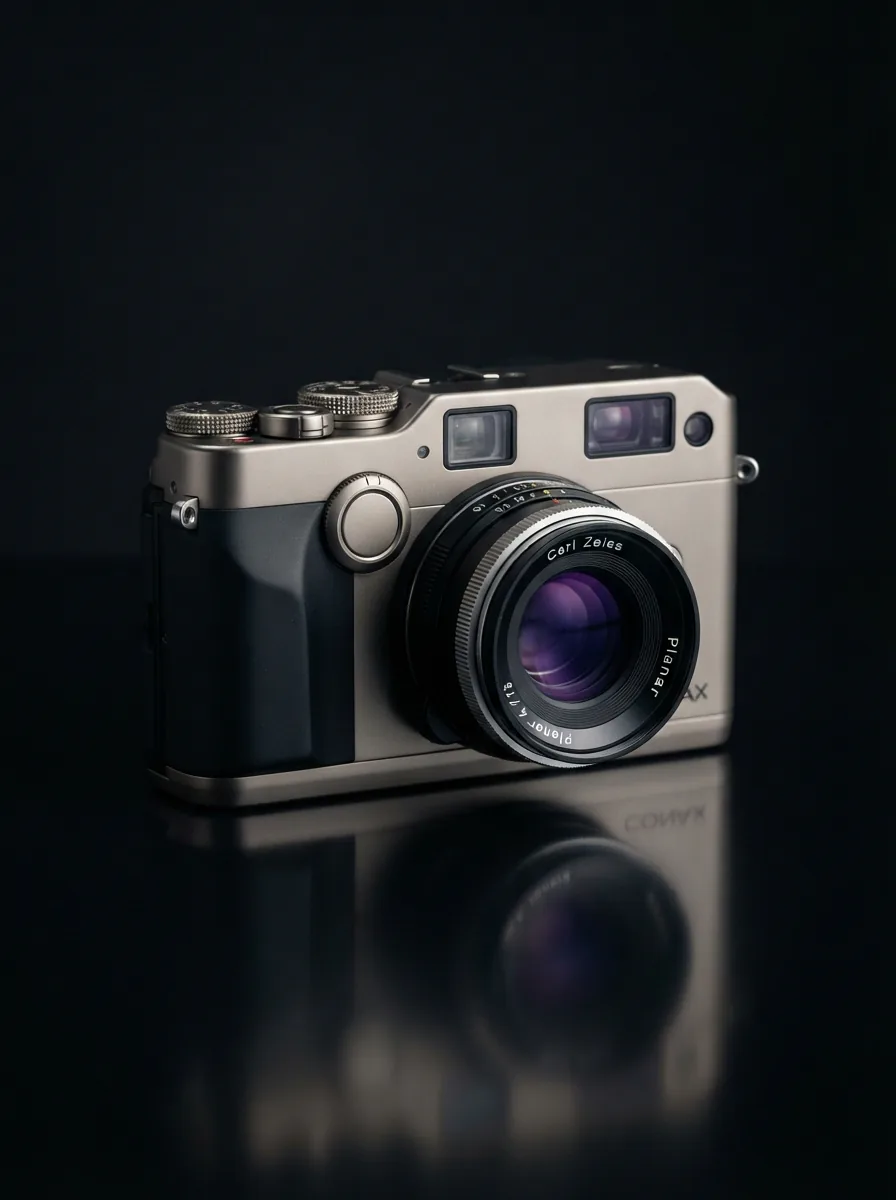
Contax G2 Camera Body
- Electronic 35mm film (24x36mm) rangefinder camera.
- Electronic autofocus.
- Motorized advance and rewind.
Why this 90s gem continues to captivate photographers in the digital age
In the ever-evolving landscape of photography, certain cameras transcend their era to become timeless tools of creative expression. Among these rare gems, the Contax G2 stands as perhaps the most sophisticated rangefinder camera ever created—a bold claim, but one I’m prepared to defend after years behind its titanium facade. As film photography experiences its renaissance in 2025, this masterpiece of German engineering and Japanese precision manufacturing deserves a fresh examination.
The moment you hold a Contax G2, you understand why it commands such reverence among photographers. Its titanium body feels substantial yet perfectly balanced in your hands—a tactile experience that no digital camera has ever quite managed to replicate. The mechanical precision of its controls, the satisfying click of its shutter, and the breathtaking quality of its Zeiss lenses combine to create something more than a camera—it’s a photographic instrument in the truest sense.
But is this legendary status justified? Is a 90s film camera worth seeking out in 2025? And can it still deliver results that stand up against modern digital contenders? Let’s explore what makes the Contax G2 such an enduring icon and whether it deserves a place in your photography kit today.
The Evolution: From G1 to G2—A Photographer’s Dream Realized
To understand the G2, we must first acknowledge its predecessor. The Contax G1, released in 1994, was revolutionary—an autofocus rangefinder with interchangeable lenses and Zeiss glass. However, it wasn’t without flaws. Its autofocus was sometimes hesitant, the viewfinder lacked brightness, and the ergonomics felt slightly unrefined.
Enter the G2 in 1996. Rather than a mere update, the G2 represented a comprehensive rethinking of the G system. The most significant improvements included:
- A completely overhauled autofocus system that worked twice as fast
- A larger, brighter viewfinder with improved frame lines
- Enhanced ergonomics with a more substantial grip and repositioned controls
- Dual control dials for easier exposure adjustments
- A more sophisticated electronic system allowing for 1/6000 second shutter speed
- Improved flash synchronization and metering
The transformation was dramatic. What had been an interesting but sometimes frustrating camera in the G1 became a fluid extension of the photographer’s vision in the G2. The refinements weren’t merely cosmetic—they addressed fundamental issues that professional photographers had identified.
Film photographer Jacob Stewart, whose street photography I’ve long admired, once told me: “The G1 was a brilliant idea. The G2 was that idea perfected.” This sentiment echoes across decades of reviews and personal testimonies from photographers who made the switch.
Professional Credentials: Why the G2 Found Its Way Into Pro Camera Bags
What exactly earned the Contax G2 its professional reputation? The answer lies in a combination of reliability, image quality, and versatility that few cameras of any era can match.
First, there’s the matter of construction. The titanium body isn’t just about luxury—it’s about creating a camera that can withstand professional use. Lighter than brass but stronger than aluminum, titanium provides durability without excessive weight. The G2’s weather resistance isn’t to modern standards, but it’s robust enough for most shooting conditions a professional might encounter.
Then there’s the matter of optics. The G2’s Zeiss lenses represent some of the finest glass ever created for 35mm photography. The 45mm f/2 Planar, often sold as the kit lens, delivers a signature rendering that combines sharpness with a certain indefinable character. The legendary 35mm f/2 Planar and 90mm f/2.8 Sonnar complete what many consider the essential trinity for the system.
These lenses aren’t merely good “for rangefinder lenses”—they stand among the best lenses ever made, period. Their optical performance has been extensively tested and confirmed by numerous technical reviews over the years. More importantly, they create images with a unique signature that photographers have come to treasure.
The G2’s metering system also deserves special mention. Its center-weighted approach may seem primitive compared to the sophisticated evaluative systems in modern cameras, but it’s remarkably reliable once you understand its tendencies. Many professionals appreciate this predictability, preferring a system they can consistently work with rather than an algorithm they have to trust.
Finally, there’s the matter of discretion. The G2’s near-silent operation and compact profile make it ideal for documentary and street photography—disciplines where being unobtrusive is essential. Compared to the mechanical clunk of a Leica or the mirror slap of an SLR, the G2 practically whispers.
Documentary photographer Elena Ramirez notes: “When I’m documenting sensitive situations, the last thing I want is a camera that announces itself. The G2 lets me become almost invisible. That’s invaluable for my work.”
The Contax G2 in 2025: Relevance in a Digital World
Is a film camera from 1996 still relevant in 2025? The answer depends largely on what you’re seeking in your photographic experience.
If your priority is immediate results, maximum technical flexibility, and integration with digital workflows, then obviously a digital camera makes more sense. But if you’re drawn to film photography for its deliberate process, unique rendering, and the tangible artifacts it produces, the G2 offers advantages that remain compelling nearly three decades after its introduction.
The current film renaissance isn’t just about nostalgia—it’s about photographers discovering (or rediscovering) the distinct qualities that analog photography brings to their work. Film forces mindfulness in composition and exposure. It creates a different relationship with the subject. And yes, it produces images with characteristics that digital still struggles to authentically replicate.
Within this context, the G2 offers a unique proposition: the mechanical-optical experience of film photography combined with autofocus convenience and lens interchangeability. It bridges the gap between fully manual film cameras and modern digital systems in a way few other cameras can manage.
What’s particularly impressive is how the G2’s autofocus system, once cutting-edge, still feels competent today. While not as fast as modern mirrorless cameras, it’s reliable enough for most situations and allows photographers to focus on composition rather than technical operation. This makes the G2 an excellent entry point for digital photographers curious about film.
Fashion photographer Marco Chen, who regularly alternates between digital and film systems, observes: “The G2 is my perfect weekend camera. I spend all week shooting digital for clients, but when I want to reconnect with what made me fall in love with photography, I reach for the G2. It slows me down just enough without feeling cumbersome.”
The Practical Pursuit: Finding and Buying a Contax G2 in 2025
If you’re convinced that a G2 belongs in your future, the next question is practical: where and how do you get one?
The G2 has appreciated significantly in value over the past decade. What once sold for $500-700 now regularly commands $1,500-2,000 for a body in excellent condition. Add the coveted 45mm Planar, and you’re looking at another $500-700. Complete kits with multiple lenses can easily exceed $3,000.
This appreciation reflects both the camera’s enduring quality and the broader trend of film camera prices rising as manufacturing has ceased while interest has grown. It’s worth noting that the G2 has consistently outpaced inflation in its value retention—a testament to its lasting appeal.
Your best options for purchasing include:
- Specialized camera dealers: Businesses like KEH Camera, Bellamy Hunt’s Japan Camera Hunter, and Classic Camera Store regularly stock G2 equipment. They typically offer warranties and have carefully checked the equipment, though you’ll pay a premium for this security.
- Online marketplaces: eBay, Facebook Marketplace, and forums like Fred Miranda offer more competitive prices but with greater risk. When buying this way, look for sellers with established feedback and clear, detailed photographs of the equipment.
- Local camera stores: Some brick-and-mortar shops with used departments occasionally receive G2 equipment. The advantage here is the ability to inspect before purchasing.
- Camera fairs and meetups: These events can be treasure troves for used equipment, often at negotiable prices.
When evaluating a potential purchase, pay special attention to:
- Autofocus functionality: Test through the full range if possible.
- Viewfinder clarity: Look for clean, bright viewing with clear frame lines.
- Film advance: Should be smooth without hesitation.
- Battery chamber: Check for corrosion, a common issue with older cameras.
- Lens mount: Ensure it’s clean and undamaged.
- Light seals: These can deteriorate over time.
Remember that while mechanical issues can often be repaired, electronic problems may be terminal due to the scarcity of parts. This makes thorough testing essential before purchase.
The Glass Arsenal: Understanding Contax G Lenses
The heart of any camera system is its lenses, and the Contax G series is no exception. What makes these lenses special is not just their optical quality but their unique design—optimized specifically for the G system’s rangefinder design and short flange distance.
The complete lineup includes:
- 21mm f/2.8 Biogon: An ultra-wide lens with minimal distortion
- 28mm f/2.8 Biogon: A classic wide-angle with exceptional corner-to-corner sharpness
- 35mm f/2 Planar: Often considered the crown jewel of the system, combining speed with outstanding image quality
- 45mm f/2 Planar: The “normal” lens that many consider perfect for everyday photography
- 90mm f/2.8 Sonnar: A portrait lens with beautiful rendering of out-of-focus areas
- 35-70mm f/3.5-5.6 Vario-Sonnar: The only zoom in the lineup
Among these, the 35mm and 45mm Planars, along with the 90mm Sonnar, form what many consider the essential trinity. Each has distinct characteristics that complement the others.
The 45mm f/2 Planar deserves special mention as perhaps the perfect “standard” lens. Its rendering combines clinical sharpness with a certain warmth that’s difficult to describe but immediately recognizable in prints. It’s often compared to the legendary 50mm f/1.4 Planar for the Contax SLR system, though with its own distinct character.
One critical point about G lenses: they cannot be adapted to other camera systems in a way that maintains focus to infinity. While adapters exist that allow them to be mounted on mirrorless cameras, these effectively turn them into close-focus or macro lenses only. This limitation has kept demand (and prices) for G lenses somewhat lower than might otherwise be expected given their quality.
Landscape photographer Thomas Wright explains: “I’ve used virtually every 35mm lens on the market over my career, and the G Planars have a rendering that’s simply different. There’s a three-dimensionality to the images that I haven’t found elsewhere. It’s subjective, but once you see it, you recognize it immediately.”
The Practical Experience: Using the Contax G2
Loading Film and Getting Started
One of the G2’s strengths is its user-friendly design. Loading film is straightforward:
- Open the back by sliding the release switch.
- Place the film canister in the chamber.
- Pull the leader across to the take-up spool.
- Close the back, and the camera automatically advances to the first frame.
The G2 reads DX-coded film canisters to set ISO automatically, though you can override this manually. This automatic feature eliminates one potential source of error for those new to film photography.
Once loaded, operating the G2 feels intuitive. The main shooting controls—aperture, shutter speed, exposure compensation—are all accessible without removing your eye from the viewfinder once you’ve learned their positions. The dual command dials make adjustments quick and precise.
Autofocus Performance: The G2’s Greatest Triumph
The autofocus system represents the G2’s most significant technical achievement. Using an active infrared system rather than the passive contrast detection found in most autofocus cameras, it works effectively even in low light and with low-contrast subjects.
While not as fast as modern digital cameras, the G2’s autofocus is remarkably reliable once you understand its behavior. The central focus point is precise, though it requires a certain technique:
- Compose with your subject centered.
- Half-press to achieve focus.
- Maintain the half-press while recomposing.
- Fully press to capture the image.
This focus-and-recompose technique becomes second nature with practice. For subjects in motion, the continuous autofocus mode provides reasonable tracking ability, though it’s not comparable to modern sports-oriented DSLRs.
Street photographer Sophia Lin notes: “The G2’s autofocus has a learning curve, but once you’ve internalized its behavior, it becomes incredibly reliable. I rarely miss focus these days, even in challenging light.”
Manual Focus Option: When You Want Control
While the G2 is primarily designed as an autofocus camera, it does offer manual focus capability. This is handled through the dial on top of the camera rather than on the lens itself—a design choice that initially feels strange but becomes natural with practice.
The manual focus works with distance markings in the viewfinder rather than through a traditional rangefinder patch. This system is less intuitive than a true manual rangefinder but serves well for pre-focusing in situations where you can anticipate subject distance.
Low Light Performance: Surprisingly Capable
The G2’s performance in low light exceeds expectations for a film camera of its era. Several factors contribute to this capability:
- The bright Zeiss lenses, particularly the f/2 Planars
- The effective infrared autofocus system that works in near darkness
- The reliable center-weighted metering
- The solid stability of the camera when handheld
Combined with modern high-ISO films like Kodak Portra 800 or Ilford Delta 3200, the G2 can handle most low-light situations comfortably. The built-in flash provides additional options when ambient light simply isn’t sufficient.
Contax G2 vs. Leica: A Different Philosophy
No discussion of rangefinder cameras can avoid the Leica comparison. The G2 and Leica M cameras represent fundamentally different approaches to rangefinder photography.
Leica rangefinders are mechanical marvels built around a manual focus system that many photographers find uniquely engaging. The rangefinder patch provides a precise focusing method that, with practice, becomes both fast and intuitive. Leicas are about the direct connection between photographer and subject, with minimal technology intervening.
The G2, in contrast, embraces technology in service of the photographic process. Its electronic shutters, autofocus system, and autoexposure capabilities eliminate technical barriers, allowing the photographer to concentrate on composition and timing.
Neither approach is inherently superior—they simply serve different photographic philosophies. Many serious photographers eventually own both, using each for different situations or moods.
What’s fascinating is how both systems have retained their value and relevance despite the digital revolution. This speaks to the fundamental quality of their design and the enduring appeal of their distinct shooting experiences.
Documentary photographer David Chen, who regularly works with both systems, offers this perspective: “My Leica makes me feel like a craftsman. My G2 makes me feel like a journalist. Both are valuable states of mind depending on the work I’m doing.”
Common Issues and Maintenance: Keeping Your G2 Running
Like any sophisticated machine approaching its third decade, the G2 can develop certain issues. Being aware of these potential problems helps in both purchasing decisions and ongoing maintenance:
Common Problems
- Battery corrosion: The CR2 battery chamber can suffer from leakage over time, potentially damaging circuits.
- Focus motor failures: The autofocus motor can wear out after extensive use.
- Film advance issues: The electronic film advance mechanism sometimes develops irregularities.
- Viewfinder dimming: The LCD frame lines in the viewfinder can fade over time.
- Shutter inconsistencies: At very high speeds, some units develop uneven exposures.
Preventative Maintenance
To keep your G2 in optimal condition:
- Remove batteries during storage: This prevents potential leakage damage.
- Exercise all functions regularly: Even if not shooting, cycle through all controls occasionally.
- Keep the lens mount clean: Dust in the mount can affect lens communication.
- Use lens hoods: These protect the front elements from damage.
- Store in a dry environment: Humidity is the enemy of electronic components.
Finding repair services for the G2 has become challenging as Contax no longer exists as a brand. However, specialists like Precision Camera Works in the US and Japan Camera Hunter in Japan still offer repair services. These specialists maintain stocks of parts harvested from donor cameras, allowing them to keep working examples functioning.
The G2’s largely electronic nature means that some failures can be terminal—a reality that prospective buyers should acknowledge. This contributes to the premium prices for well-maintained examples.
The Digital Age Alternative: What Compares to the G2 Today?
For those attracted to the G2’s concept but hesitant about film, what digital alternatives exist?
The closest spiritual successors include:
- Fujifilm X-Pro3: With its hybrid viewfinder and rangefinder-inspired design, the X-Pro3 captures some of the G2’s shooting experience in a digital format.
- Leica Q2: Though fixed-lens, the Q2 offers a similar premium compact experience with exceptional optics.
- Sony Alpha 7C: Offers the compactness and full-frame quality in a modern package, though with a different shooting experience.
None perfectly replicate the G2 experience, which combines:
- The tangibility of film
- The precision of Zeiss optics
- The hybrid manual/automatic control system
- The unique rangefinder shooting style
This inability to fully replicate the G2 experience digitally helps explain its enduring appeal and value among photographers who appreciate its particular combination of qualities.
Conclusion: Is the Contax G2 Right for You in 2025?
After examining the Contax G2 from every angle, we return to our original question: is this 90s film camera worth acquiring in 2025?
For the right photographer, the answer is an emphatic yes. The G2 continues to offer:
- Exceptional image quality through its Zeiss lenses
- A uniquely engaging shooting experience
- The distinctive aesthetic qualities of film
- A balance of automation and control
- A tangible investment that has historically appreciated in value
However, it’s not for everyone. The G2 may not be your ideal choice if:
- You require immediate image review
- You frequently shoot in extreme conditions
- You need modern autofocus tracking performance
- You’re on a tight budget
- You don’t have access to film processing
The true magic of the Contax G2 lies in how it transforms the act of photography. It occupies a sweet spot between the fully manual film cameras of the past and the hyper-automated digital cameras of today. It demands enough of your attention to keep you engaged but handles technical details efficiently enough to let you focus on creative decisions.
In a world of increasingly disposable technology, there’s something profoundly satisfying about using a tool designed with such care and precision—a tool that continues to deliver exceptional results decades after its creation. The G2 isn’t merely a camera; it’s a statement about what matters in photography: the connection between photographer and subject, the quality of the captured image, and the joy of the process itself.
As we navigate an increasingly digital world, perhaps there’s special value in tools that remind us of the physical nature of photography—the chemistry of film, the precision of mechanical controls, the weight of a well-crafted instrument in your hands. In this context, the Contax G2 isn’t just relevant; it’s essential—a tangible connection to photography’s rich heritage and a reminder of what matters most in image-making.
Whether you’re a film photography veteran or a digital native curious about analog processes, the G2 offers a unique window into what makes photography special. And in that sense, it remains as relevant in 2025 as it was when it first appeared nearly three decades ago.