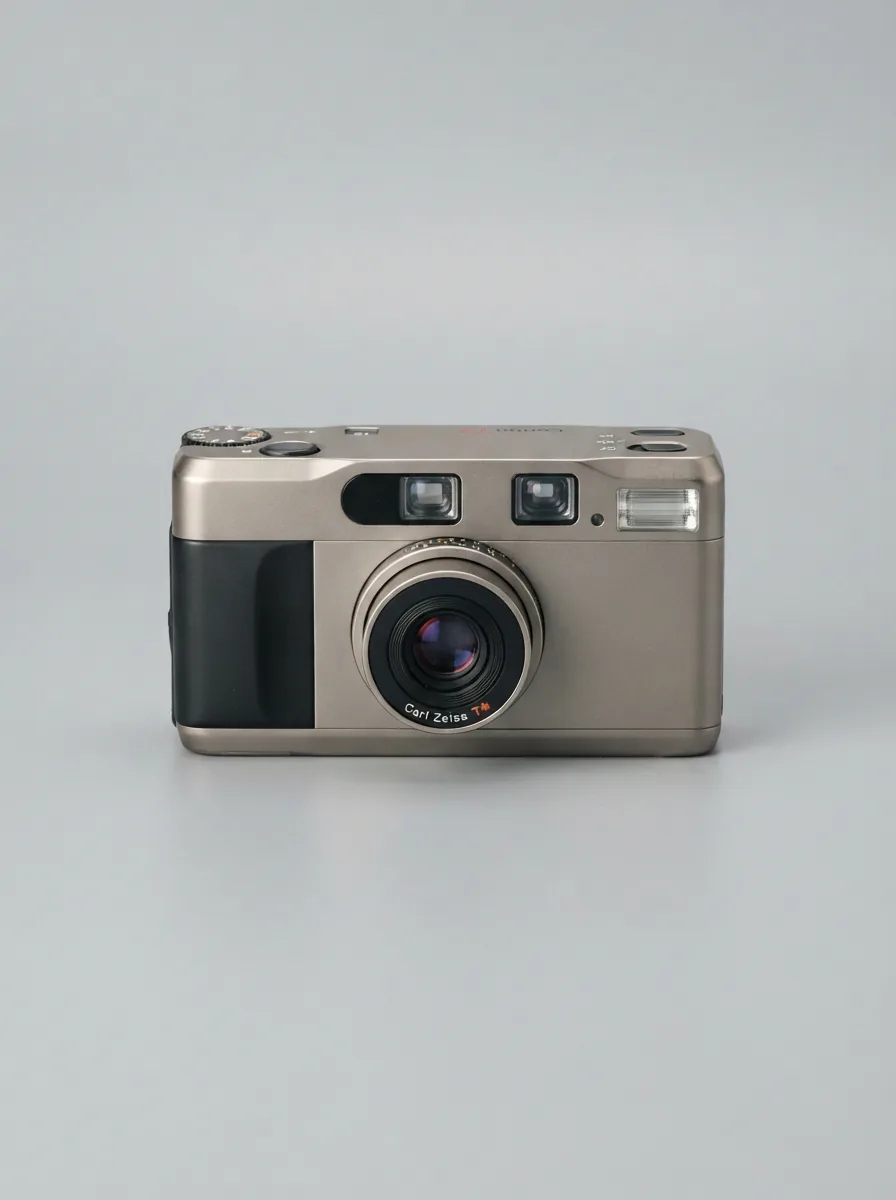
CONTAX T3 Black Titan 35mm Point & Shoot Film Camera
- The Contax T3, which arguably is the finest film point & shoot ever made.There are two colors of silver and black model color. It combines the best of almost every model listed here and crams them all into one single titanium body. Contax spared no expense in making this an extremely durable and reliable camera, attached with a Carl Zeiss Sonnar 35mm f/2.8 gem of a lens that can focus closer (up to .4m) and more quickly than the Contax T2.
Exploring the Legacy of a Pocket-Sized Powerhouse in the Digital Age
In the world of analog photography, few cameras have achieved the mythical status of the Contax T3. This diminutive titanium wonder continues to captivate photographers decades after its release, commanding eye-watering prices on the secondary market and appearing in the hands of celebrities and professional photographers alike. But what exactly makes this particular compact film camera so special? Is it truly deserving of its legendary reputation, or is it simply another victim of nostalgic hype and collector frenzy?
As someone who has spent countless hours with various film cameras, I’ve always been intrigued by the almost religious devotion the T3 inspires. There’s something about this particular camera that transcends typical gear enthusiasm and enters the realm of genuine reverence. Today, I’m diving deep into the Contax T3 phenomenon to understand why this particular camera continues to be the ultimate expression of compact film photography excellence.
The Origin Story: When German Engineering Met Japanese Precision
Before we dissect what makes the T3 special, it’s worth understanding its lineage. The Contax brand itself has a storied history, originally established by Zeiss Ikon in Germany during the 1930s as a direct competitor to Leica. After World War II, the rights to the Contax name eventually made their way to Kyocera in Japan, who produced the legendary T series of compact cameras.
The T3, released in 2001, represented the culmination of this German-Japanese partnership. It was the final and most refined entry in the T series, following the successful T2 model. What’s particularly poignant about the T3 is that it arrived just as digital photography was beginning to take hold, making it one of the last truly high-end film compacts ever created. This timing imbued the camera with a certain elegance of purpose—a final, defiant statement of what film photography could achieve in pocket form.
The Titanium Marvel: Engineering Excellence in Your Palm
Pick up a Contax T3, and the first thing you’ll notice is its extraordinary build quality. The camera’s titanium body isn’t just a marketing gimmick—it represents a genuine commitment to creating something that would last generations. At just 277 grams (with battery) and measuring a mere 119 × 65.5 × 33mm, the T3 achieves that perfect balance between substantive and compact.
The titanium construction gives the camera a distinctive feel that’s difficult to describe until you’ve experienced it. There’s a density and solidity that’s immediately apparent, yet it remains lightweight enough to slip into a jacket pocket. This combination of durability and portability is perhaps the first clue to the T3’s enduring appeal. In an age of disposable technology, the T3 was built like a mechanical watch—something meant to be used, cherished, and passed down.
The camera’s ergonomics deserve special mention. The slightly rounded edges, the perfectly positioned shutter button with its responsive half-press for focus, and the intuitive dial controls all contribute to a shooting experience that feels natural and unobtrusive. This is a camera designed by people who understood that great photography often happens in fleeting moments—when the machinery becomes an extension of your vision rather than an obstacle to it.
The Crown Jewel: The Carl Zeiss Sonnar T* 35mm f/2.8 Lens
If the titanium body represents the T3’s armor, then the Carl Zeiss Sonnar T* 35mm f/2.8 lens is undoubtedly its heart. This lens is the primary reason photographers continue to pay premium prices for this camera decades after its production ceased. The Sonnar design dates back to the 1920s, but this modern implementation combines classic character with technical excellence.
What makes this particular lens so special? First, there’s its remarkable sharpness—even wide open at f/2.8, the center sharpness is exceptional, with the corners catching up nicely when stopped down just a bit. But sharpness alone doesn’t explain the Sonnar’s magic. It’s the lens’s rendering—that ineffable quality photographers describe as “dimensionality” or “micro-contrast”—that truly sets it apart.
Images taken with the T3 have a distinctive pop, with subjects seeming to separate themselves naturally from the background. Colors are rendered with a richness that’s difficult to quantify but immediately recognizable. The Sonnar also produces a particularly pleasing bokeh (background blur) that’s smooth without being clinical—maintaining character while avoiding the busy, nervous quality found in lesser lenses.
The T* coating (Zeiss’s proprietary multi-coating technology) minimizes flare and ghosting while enhancing contrast. This means the T3 performs admirably even in challenging lighting conditions, such as when shooting directly into light sources. The lens’s minimum focusing distance of 0.35m (about 1.15 feet) also strikes a good balance, allowing for reasonably close shots without compromising the overall compact design.
Precision Mechanics: The Autofocus System
One area where the T3 distinguished itself from its predecessor, the T2, was in its improved autofocus system. The T3 features a passive autofocus system that, while not as lightning-fast as modern digital cameras, achieves impressive accuracy for a film compact. It uses infrared triangulation to determine distance, supplemented by a contrast-detection system for fine-tuning.
What makes this system particularly noteworthy is how well it works in varied lighting conditions. While many compact cameras from this era struggle in low light, the T3’s autofocus remains relatively reliable even as the light dims. It’s not infallible—nothing from this period is—but its hit rate is remarkably high.
The camera also offers a manual focus option, activated via the focusing ring around the lens. This feature provides a level of control rarely found in compact cameras, allowing photographers to override the autofocus when necessary. For street photographers or those working in situations where predictive focusing is beneficial, this capability is invaluable.
Exposure Controls: Sophisticated Simplicity
The T3’s exposure system strikes an elegant balance between automation and manual control. The camera offers aperture-priority autoexposure, where you select the aperture and the camera determines the appropriate shutter speed (ranging from 1/500s to 16s). This approach aligns perfectly with how most serious photographers prefer to work—controlling depth of field while letting the camera handle timing.
The exposure compensation dial on the top plate allows for adjustments from -2 to +2 EV in 1/3-stop increments, providing plenty of latitude for creative expression or challenging lighting situations. There’s also an AE lock button that, when pressed, retains the current exposure reading—incredibly useful for recomposing shots after metering.
For those who prefer complete control, the T3 also offers a manual exposure mode. This feature represents a significant advantage over many premium compacts of the era, which often limited users to automatic or semi-automatic operation. The ability to fully override the camera’s decisions gives the T3 a versatility that belies its compact dimensions.
The T3 vs. The Competition: How Does It Stack Up?
The natural comparison for the Contax T3 is its legendary predecessor, the T2. While both cameras share similar DNA, the T3 refined almost every aspect of the design. It’s smaller and lighter than the T2, features a more advanced autofocus system, and offers a slightly wider maximum aperture (f/2.8 compared to the T2’s f/2.8-f/16 range). The T3 also introduced a closer minimum focusing distance and improved ergonomics.
When compared to its primary competitor, the Leica Minilux, the T3 offers several advantages. While the Minilux features an excellent Summarit 40mm f/2.4 lens, many photographers prefer the slightly wider 35mm perspective of the T3. The T3’s titanium construction also gives it an edge in durability over the Minilux’s aluminum body. Where the Leica does score points is in its viewfinder, which many find slightly more comfortable than the T3’s.
Other high-end compacts like the Nikon 35Ti and the Konica Hexar AF offer their own strengths—the Nikon with its unique analog gauge display and the Hexar with its nearly silent operation and slightly faster f/2 lens. However, neither quite matches the T3’s combination of compact size, build quality, and optical excellence.
This brings us to perhaps the most crucial question: is the Contax T3 worth its current market price? With examples in good condition regularly fetching $1,500-2,500 (and pristine specimens going for even more), this is not an investment to be taken lightly. The answer depends largely on what you value in a camera.
If you’re seeking the absolute pinnacle of compact film camera engineering—a device that combines uncompromising image quality with pocket-sized convenience—then the T3 makes a compelling case despite its premium. Few cameras in any category deliver such a perfect synthesis of form and function. However, if you’re primarily concerned with practical considerations like value-for-money, several excellent alternatives exist at lower price points.
The T3 in Practice: Street Photography, Portraits, and Beyond
Theory and specifications tell only part of the story. How does the T3 perform in real-world shooting scenarios? In street photography, the camera truly excels. Its discreet size and quiet operation make it nearly ideal for candid shooting. The 35mm focal length provides a natural perspective that’s slightly wider than normal but not so wide as to introduce significant distortion.
The autofocus, while not blazing fast by modern standards, is more than adequate for most street situations. The ability to preset focus manually is particularly valuable in this genre, allowing you to zone focus and shoot from the hip when necessary. The lens’s excellent performance at middle apertures (f/5.6-8) provides enough depth of field for street scenes while maintaining exceptional sharpness.
For portraits, the T3 might not seem an obvious choice given its fixed 35mm lens (traditionally, 85mm-105mm lenses are preferred for portraiture). However, the Sonnar’s excellent rendering and pleasant bokeh make it surprisingly capable in this role. By moving in closer and using the wide aperture to isolate your subject, the T3 can produce intimate portraits with a distinctive look. The slightly wider perspective also allows for environmental portraits that include context around your subject.
In low-light conditions, the T3 performs admirably for a compact film camera. The maximum aperture of f/2.8 isn’t the fastest available, but it’s sufficient for most situations, especially when paired with higher-speed films like Kodak Portra 800 or Ilford Delta 3200. The camera’s accurate metering and exposure compensation capabilities also help wring the most from challenging lighting scenarios.
Film Selection: Maximizing the T3’s Potential
The beauty of film photography lies partly in the variety of emulsions available, each with its own characteristics. The T3’s excellent lens can make the most of whatever film you choose, but certain stocks seem particularly well-matched to its capabilities.
For color work, Kodak Portra 400 is a perennial favorite among T3 users. Its fine grain, excellent color rendition, and generous exposure latitude complement the Zeiss lens beautifully. For situations requiring more speed, Portra 800 maintains impressive quality while providing an extra stop of sensitivity. Those seeking more saturated colors might opt for Kodak Ektar 100 or Fujifilm Velvia, though the latter’s limited exposure latitude demands precise metering.
In the black-and-white realm, Ilford HP5 Plus and Kodak Tri-X provide classic looks with enough speed for versatile shooting. The T3’s excellent lens brings out the best in these films, rendering fine details and subtle tonal gradations with aplomb. For maximum sharpness and minimal grain, films like Ilford Delta 100 or Kodak T-Max 100 showcase just how much resolution the Sonnar lens can deliver.
Loading and Operating the T3: Practical Considerations
Despite its sophisticated capabilities, the T3 is remarkably straightforward to operate. Loading film requires sliding the catch on the base to open the back, placing the film cartridge in the chamber, pulling the leader across to the takeup spool, and closing the back. The camera automatically advances to the first frame.
The camera’s controls are equally intuitive. The mode dial on top allows selection between auto, aperture priority, and manual exposure modes. The aperture ring surrounds the lens, with settings from f/2.8 to f/16 clearly marked. Focus mode selection (auto, infinity, or manual) is controlled via a switch on the lens barrel, with the manual focus ring located at the front of the lens.
One operational quirk worth noting is the T3’s power management. The camera automatically turns off after a period of inactivity to conserve battery life. To reactivate it, you need to press the shutter button halfway. This can occasionally lead to missed shots if you’re not aware of this behavior, but it becomes second nature with use.
The Achilles Heel: Reliability and Repair
If the T3 has one significant drawback, it’s the increasing difficulty of finding repair options as these cameras age. Kyocera ceased production of Contax cameras in 2005, and the supply of parts has dwindled in the years since. The most common issues include electronic failures, sticky shutters, and problems with the autofocus system.
This reality creates something of a paradox: the T3 was built to last generations from a physical perspective, but its sophisticated electronics may not share the same longevity. Prospective buyers should factor this into their decision-making process. A working T3 today may provide many more years of faithful service, but there’s an inherent risk that repairs could become impossible if major components fail.
Some specialized repair technicians still service these cameras, but their numbers are dwindling, and costs can be substantial. This situation isn’t unique to the T3—it affects most electronic film cameras from this era—but it’s particularly poignant given the T3’s premium positioning and collectible status.
Finding a T3: Hunting for Titanium Gold
Given the T3’s cult status and limited production run, finding one in good condition requires patience and sometimes a willingness to pay a premium. The secondary market is the only option, as these cameras have been out of production for nearly two decades.
Specialized camera retailers that deal in used equipment occasionally have examples available, but they typically command top dollar due to the assurance of professional inspection and often limited warranties. Online marketplaces like eBay present more options but require careful vetting of sellers and listings.
When evaluating a potential purchase, pay close attention to:
- Functionality of all controls and the autofocus system
- Condition of the lens (look for fungus, scratches, or haze)
- Proper operation of the metering system
- Cosmetic condition (while some wear is expected, excessive brassing or dents may indicate rough handling)
- Battery chamber condition (corrosion here can be particularly problematic)
It’s worth noting that the T3 was available in two finishes: the more common black and the rarer champagne. The latter typically commands an additional premium among collectors, though functionality is identical.
Budget-Friendly Alternatives: Capturing the Spirit Without Breaking the Bank
Not everyone can—or wants to—invest the considerable sum required for a Contax T3. Fortunately, several alternatives offer similar capabilities at more accessible price points:
The Olympus Stylus Epic (mju-II) features a sharp 35mm f/2.8 lens in a weather-resistant body at a fraction of the T3’s cost. While it doesn’t match the T3’s build quality or manual controls, its optical performance is surprisingly good.
The Konica Hexar AF, mentioned earlier, offers a slightly faster 35mm f/2 lens and exceptionally quiet operation. While larger than the T3, it’s still reasonably compact and typically sells for less than half the price of a T3.
For those willing to forego autofocus, the Olympus XA series (particularly the original XA) provides excellent image quality in an incredibly compact package. These rangefinder cameras fit in a shirt pocket and feature sharp 35mm lenses.
The Nikon 28Ti and 35Ti offer similar premium builds (albeit in aluminum rather than titanium) and excellent Nikkor lenses. While still expensive, they typically sell for less than the T3.
Compatible Accessories: Expanding the T3 Experience
While the T3 is designed as a self-contained photography system, a few accessories can enhance its capabilities:
The dedicated Contax TLA 200 flash provides automatic TTL flash metering, though it does add considerable bulk to the otherwise svelte camera. For those who occasionally need flash capability, it’s a worthwhile addition.
A soft release button can improve handling, especially for those with larger hands. These screw into the threaded shutter button and provide a larger surface area for more comfortable shooting.
Various cases are available, from original Contax leather cases to third-party options. These protect the camera while still allowing quick access for shooting.
UV or protection filters can be mounted on the lens to protect the front element, though some purists prefer to shoot without filters to avoid any potential impact on image quality.
The Legacy of the T3: Why It Matters
As we approach the conclusion of our exploration, it’s worth considering the broader significance of the Contax T3. Beyond its technical specifications and performance characteristics, what does this camera represent in the broader context of photography?
I believe the T3 embodies a particular philosophy of camera design—one that prioritizes the essential elements of photography while eliminating anything superfluous. It represents the idea that serious photographic tools needn’t be large or intimidating, that excellence can come in small packages.
The T3 also serves as a bridge between eras. Released at the dawn of the digital age, it carried forward the best aspects of mechanical camera design while incorporating electronic aids that enhanced rather than detracted from the photographic experience. In doing so, it created something timeless—a camera that feels as relevant and capable today as it did when first released.
Perhaps most importantly, the T3 reminds us that the tools we use to create images matter not just for their technical capabilities but for how they make us feel while using them. The joy of holding and operating a beautifully crafted object connects us more deeply to the creative process. In an age of increasingly homogenized digital devices, the distinct personality of cameras like the T3 becomes all the more precious.
Final Verdict: Is the T3 Still Relevant in 2025?
After all this analysis, we return to our original question: is the Contax T3 truly the ultimate compact film camera, and does it deserve its legendary status?
The answer, I believe, is a qualified yes. From a purely objective standpoint, the T3 represents a high-water mark in compact camera design that has rarely, if ever, been surpassed. Its combination of size, build quality, optical excellence, and thoughtful controls created something that transcends the sum of its parts.
However, the T3’s ultimate value isn’t objective—it’s deeply personal. For those who connect with its particular approach to photography, who appreciate its tactile qualities and the images it produces, the T3 can be worth every penny of its premium price. For others, its advantages may seem incremental compared to more affordable alternatives.
What remains undeniable is the T3’s enduring impact. In a world where cameras have become increasingly disposable—replaced by newer models with marginal improvements—the T3 stands as a reminder that some tools are worth preserving, celebrating, and using for decades. In that sense, perhaps its greatest achievement is proving that true photographic excellence never becomes obsolete.
Whether you’re a longtime T3 owner, a curious enthusiast considering your first premium compact, or simply someone who appreciates the intersection of art and engineering, the Contax T3 offers lessons in how thoughtful design can create objects that transcend their utilitarian purpose to become something approaching art.