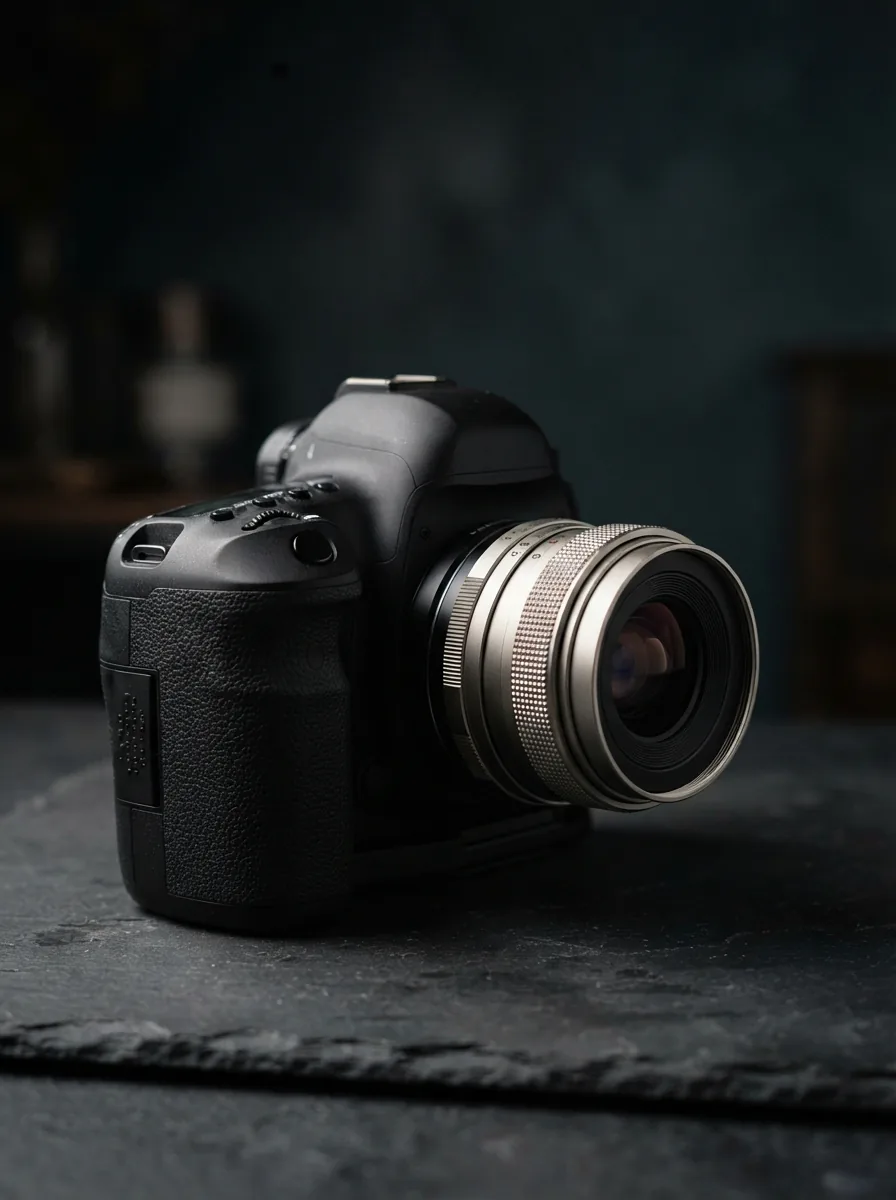
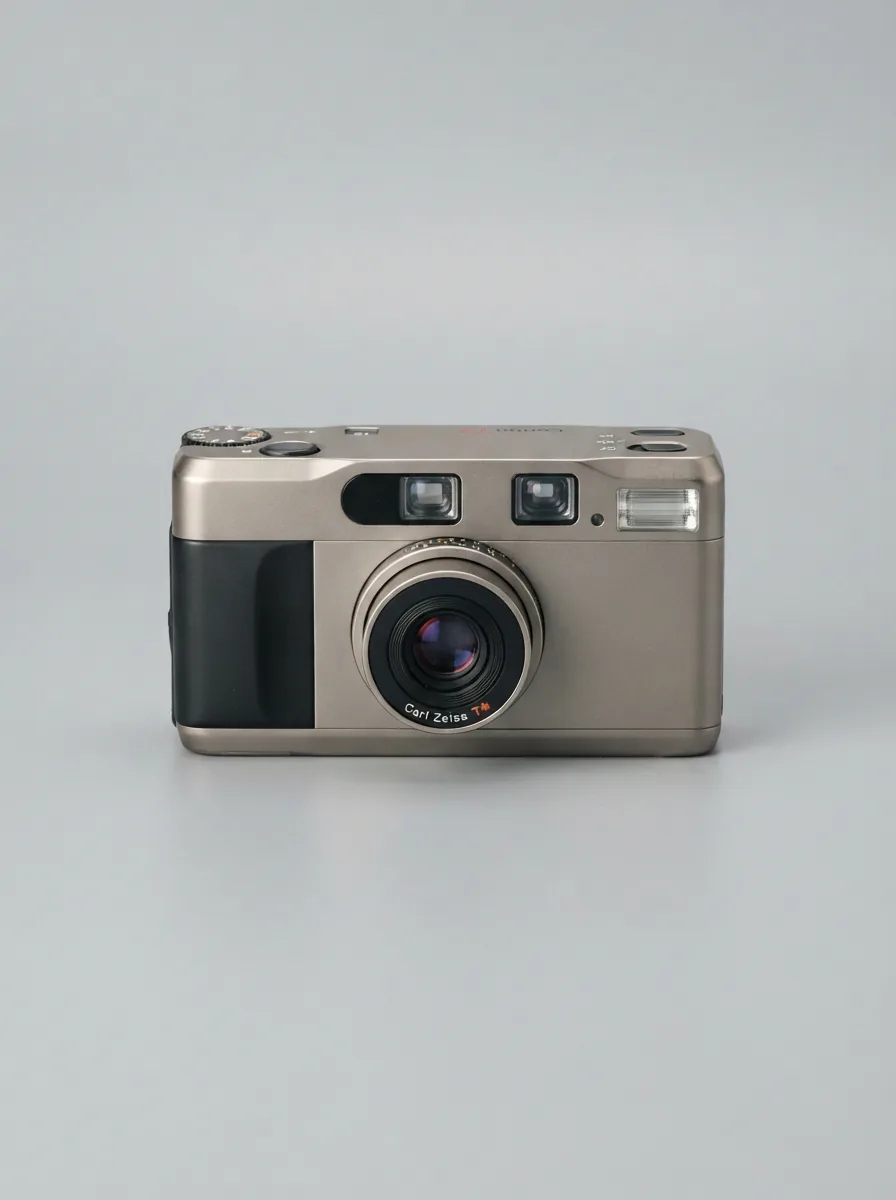
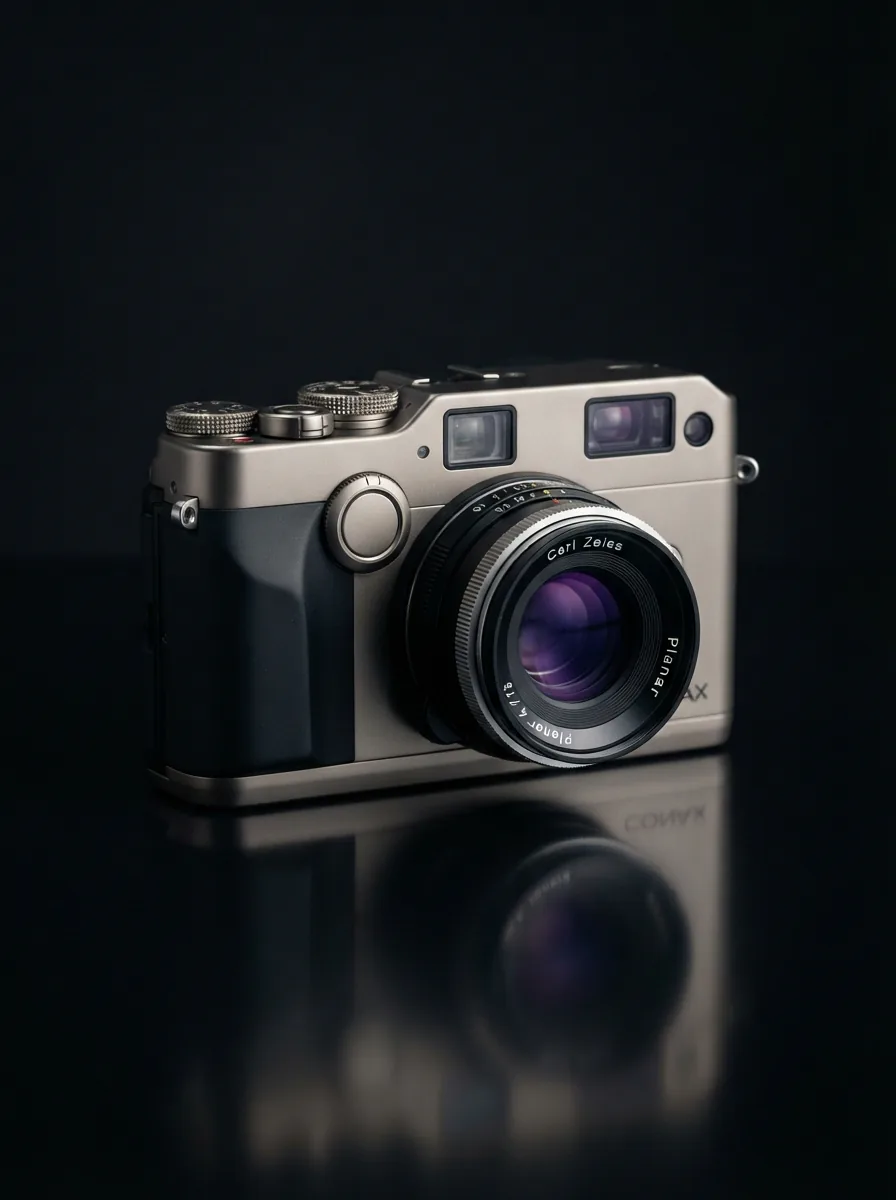
There are cameras that take photographs, and then there are cameras that redefine what photography can feel like. The Contax T3 Black sits without question in the second group. Born from a collaboration between Kyocera and the legendary optical house of Carl Zeiss, the T3 is a 35mm compact film camera that has long since transcended its original product category to become one of the most celebrated, passionately collected, and critically admired photographic tools of the modern analogue era. In its titanium black finish — deep, authoritative, and quietly spectacular — it is arguably the most aesthetically compelling expression of a camera that was already a masterpiece in silver. More than three decades after its initial release, the Contax T3 Black continues to define what a carry-everywhere film camera can and should be. Whether you are a seasoned film photographer trying to understand exactly what makes this camera so special, or a collector weighing a significant investment in an analogue icon, what follows is everything you need to know — told with the honesty and depth the camera genuinely deserves.
Five Most Popular Contax T3 Black Models
The Contax T3 Black was manufactured across several distinct production variants, each carrying its own collector following, production history, and pricing tier. Understanding which variant you are considering is essential before entering this market. Here are the five most popular configurations currently available.
1. Contax T3 Titan Black Double Teeth (Top MINT)

The Double Teeth designation refers to a specific configuration of the film transport mechanism’s sprocket wheel, and it has become one of the defining markers of collector desirability in the T3 world. The Double Teeth variant comes from a later, more refined production run and is widely regarded as the definitive Contax T3 Black — combining mature manufacturing precision with the camera’s full feature set. In Top MINT condition, these examples show virtually no signs of use and represent the camera performing and presenting at its absolute best. Sought by working photographers and dedicated collectors in equal measure, this is the benchmark against which all other T3 Black variants are measured.
- Rating: ★★★★★
- Price Range: $3,499.99 – $4,599.99
2. Contax T3 Titan Black Single Teeth

The Single Teeth variant occupies an earlier chapter of the T3’s production history. While the underlying camera is optically and functionally identical — carrying the same extraordinary Zeiss glass, the same titanium body, and the same shutter and metering systems — it represents a distinct production period with its own character. For photographers who want to experience the T3 Black without entering the elevated pricing of the Double Teeth tier, the Single Teeth model remains a deeply compelling option, delivering everything that made this camera legendary with a slightly more accessible entry point into the market.
- Rating: ★★★★★
- Price Range: $2,589.00 – $2,899.99
3. Contax T3D Titan Black (Data Back)

The T3D is the data back version of the T3 Black, adding a date-imprint function to the already formidable feature set of the standard model. For photographers with a documentary or archival sensibility — or for those who simply value the ability to record shooting dates directly onto the negative — this variant adds genuine practical value without compromising anything in the core camera experience. Near MINT examples of the T3D Black, particularly those that have been film-tested and verified by specialist dealers, represent some of the most comprehensively capable configurations the T3 Black was ever offered in.
- Rating: ★★★★★
- Price Range: $2,189.00 – $3,999.99
4. Contax T3 Black 70th Anniversary Limited Edition

Produced to mark the 70th Anniversary of the Contax brand, this limited edition variant in black is among the rarest configurations the T3 was ever offered in. While sharing the same core specifications as the standard model — the same Sonnar lens, the same titanium chassis, the same feature architecture — the 70th Anniversary designation layers on a dimension of historical significance and collector cachet that the market has consistently rewarded with premium pricing. Excellent-condition examples are genuinely scarce, and their appearance in listings tends to attract immediate, serious attention from discerning buyers.
- Rating: ★★★★★
- Price Range: $3,399.99 – $3,799.90
5. Contax T3 Titan Black Late Double Teeth with Case

The Late Double Teeth designation identifies examples from the final production runs of the Contax T3 Black — cameras manufactured near the end of the model’s production life that benefit from the full maturation of the design. When accompanied by their original leather case, these examples offer both a superbly functional shooting instrument and a collector piece that retains an authentic sense of completeness. Late production specimens with higher serial numbers are particularly prized for the refinement they represent, and boxed examples in Top MINT condition command pricing that reflects their rarity and desirability.
- Rating: ★★★★★
- Price Range: $3,399.99 – $4,299.00
The Heritage Behind the Black Titanium
To fully appreciate why the Contax T3 Black commands both the respect and the prices it does, it is necessary to understand the lineage it carries. The Contax T-series compact cameras represent one of the most significant and coherent product lines in the entire history of 35mm photography. Beginning with the original Contax T, progressing through the Contax T2, and culminating in the T3, each generation refined the core proposition of a pocketable camera built to no optical compromises whatsoever.
The T2, which directly preceded the T3, was itself a landmark camera that remains one of the most beloved film compacts ever made. But the T3 surpassed it in several meaningful and practical ways. Most importantly, the minimum focusing distance was halved — from 70cm on the T2 down to just 35cm on the T3 — opening up compositional possibilities that the earlier model simply could not accommodate. The T3 also introduced a more refined ergonomic language and a sophisticated custom function system that gave photographers a degree of behavioural control over their camera that was almost without precedent in the compact category.
The use of titanium for the body is not merely a premium marketing gesture. Titanium is approximately twice as strong as steel relative to its weight, and its selection here reflects a genuine engineering philosophy: this camera is built to be carried everywhere, every day, without ceremony or anxiety, for decades. The black titanium finish — achieved through a controlled surface treatment that gives the metal its characteristic deep, matte-dark tonality — adds a visual gravity and seriousness that the silver version, beautiful as it undoubtedly is, does not quite replicate. The black T3 is the camera of photographers who prefer their tools to be understated, purposeful, and quietly exceptional.
The Zeiss Sonnar Lens: An Objective Case for Optical Excellence
Any serious conversation about the Contax T3 Black must ultimately centre on its lens, because the lens is the reason this camera exists at the price it does. The 35mm f/2.8 Carl Zeiss Sonnar T* is not simply a capable optic by compact camera standards. It is an exceptional lens by any standard at all. Experienced reviewers have noted that the T3’s lens performs not merely as well as the glass found in larger system cameras, but in some measurable respects better — sharper than many legacy standard primes, and more resistant to flare than optics that cost several times as much and weigh considerably more.
The Sonnar design in Zeiss hands produces images defined by extraordinary resolution and contrast across the entire frame, a natural and faithful rendering of colour and tone, and a bokeh quality — the character of out-of-focus areas — that is smooth, organic, and genuinely pleasing to look at. The five-blade aperture diaphragm produces well-defined, uniform exposures from the maximum aperture of f/2.8 down to the minimum of f/16, making the camera equally capable in the intimate low-light scenarios where wide apertures matter and in the expansive daylight situations where depth of field is desired throughout the frame.
The focal length of 35mm is, in the considered view of many experienced photographers, the single most versatile focal length available for everyday documentary, travel, and street work. It is wide enough to capture context, environment, and the relationship between a subject and its surroundings. It is tight enough to maintain a natural, undistorted perspective without requiring the photographer to work at an awkward or intrusive proximity. At 35mm, with this particular Sonnar lens in front of it, the T3 Black makes the very most of what this focal length can offer — and the titanium chassis surrounding it places no limitations on what the photographer can ask of it.
Technical Specifications That Matter
The Contax T3 Black is, by the standards of any era, an impressively specified machine. Its shutter speed range runs from 16 seconds all the way to 1/1200 second — a span that provides meaningful capability in both the dimmest available-light interior environments and the brightest midday outdoor conditions. The camera reads DX-coded film cassettes automatically across an ISO range of 50 to 5000, covering every film stock a serious photographer is likely to encounter, from slow-speed daylight transparency films to pushed high-speed monochrome stocks.
Shooting modes include Program and Aperture Priority, with the latter enabling the photographer to exercise direct creative control over depth of field and exposure character without requiring any move to a heavier, more complex system camera. The metering system is centre-weighted, providing an intelligent reading of the primary subject area while allowing the photographer to adjust for challenging lighting situations by pointing the camera at different areas of the scene. The viewfinder displays a continuously updated shutter speed readout using four reference markers — LT (Long Time), 30, 125, and 500 — that communicate exposure conditions clearly and practically without overwhelming the act of composition with unnecessary data.
One of the T3’s most distinctive and genuinely useful features is its AF-L button, which allows focus to be locked independently of exposure metering. This is, functionally, the compact camera equivalent of the back-button autofocus found on professional digital SLR systems, and in practice it enables a level of creative control over the relationship between focus point and metering point that elevates the T3 far above the capacities of a conventional point-and-shoot. For photographers who understand how to use this feature — locking focus on the subject, then recomposing and metering from a different area of the scene — the T3 Black becomes a genuinely expressive tool rather than a passive recording device.
The camera’s seven custom functions are one of its less-celebrated but most practically important assets. They allow configuration of everything from the default flash mode (which most serious photographers set to flash-off as a permanent default) to whether exposure compensation is retained between shots or reset each time, whether manual focus distance is remembered after the camera is powered off, and whether the AF-L button locks focus alone or both focus and exposure simultaneously. This level of personalisation, accessible through a specific sequence of button presses while the camera is powered off, rewards the photographer who invests the time to understand it — and results in a camera that behaves precisely and consistently in the way its owner intends, every single time it is picked up.
The viewfinder, featuring synthetic sapphire glass, is notably bright, clear, and informative. It displays focus confirmation, shutter speed readout, and flash status simultaneously, and while it lacks the active parallax correction found in some competing cameras, its legibility across a wide range of lighting conditions makes it a genuine pleasure to compose through. The camera’s dimensions — 4.13 inches wide, 2.48 inches tall, and just 1.2 inches deep — ensure that it disappears into almost any pocket or bag without complaint, and its weight of 0.71 pounds means it is genuinely not felt over the course of a full day’s carry.
Why the Black Finish Is More Than Skin Deep
It would be tempting to characterise the preference for the T3 Black over the T3 Silver as a matter of pure personal taste. In reality, the distinction is more substantive. The black titanium variant has always commanded a consistent premium in the collector market — a reflection not merely of aesthetic preference but of the demonstrably lower production volumes in which black examples were manufactured. Fewer black T3s exist, fewer survive in excellent condition, and when clean examples of meaningful variants appear on the market, they attract competitive and sustained attention from buyers who understand exactly what they are looking at.
There is also a practical photographic argument for the black finish. A silver camera is more visible, more conspicuous in public environments, and in certain conditions more likely to alter the natural behaviour of the people around the photographer. The black T3 is quiet and unannounced — a tool that does not draw attention to itself or to the act of picture-making. For photographers working in street, travel, or documentary contexts, this is not a cosmetic consideration. It is an operational one, and it has direct implications for the kinds of photographs the camera allows its user to make.
The Market Today: What to Expect When Buying
The contemporary market for the Contax T3 Black reflects both the camera’s genuine and irreplaceable excellence and the broader, sustained surge of serious interest in premium analogue photography that has defined the past decade. Listings on major secondary market platforms consistently place Near MINT examples in the $2,500 to $4,000 range, with Top MINT Double Teeth examples — particularly boxed specimens accompanied by original accessories — regularly exceeding $4,500. Limited edition variants and late production examples push the ceiling higher still.
Specialist Japanese dealers, many of whom source directly from the domestic Japanese market where the T3 was especially popular during its production life, tend to offer comprehensively documented examples supported by detailed condition grading and film-tested verification of functionality. At this price point, the diligence of purchasing from a reputable source with a clearly communicated and consistently applied condition standard — graded against categories such as MINT, Near MINT, Excellent+, and Excellent — is not merely advisable. It is essential protection against expensive disappointment.
Understanding the Double Teeth versus Single Teeth distinction before committing to a purchase is equally important. While the photographic output of the two variants is identical in every meaningful way — the lens and shutter perform the same regardless of sprocket wheel configuration — the market has established a consistent and durable preference for Double Teeth examples, and pricing reflects this reality across every platform and dealer category.
A Camera That Justifies Every Penny
The history of photography is filled with tools that were remarkable in their moment and have since quietly faded into obsolescence. The Contax T3 Black is the precise opposite of this narrative: a camera that was extraordinary when new, that has grown in stature and relevance with every passing year, and that today sits unchallenged at the summit of the compact 35mm film camera world. No contemporary manufacturer produces anything that credibly combines the T3’s optical quality, engineering character, feature depth, and genuinely pocketable dimensions in a single package. The camera is, in the most literal sense, irreplaceable.
For the photographer who shoots on film and refuses to compromise on the quality of what they carry, the Contax T3 Black is not simply a strong recommendation. For many, it is the only answer. And for the collector who understands the rare convergence of design heritage, optical excellence, and enduring cultural significance that this camera embodies, it is an acquisition that requires no further justification. The market has rendered its verdict clearly and consistently over more than three decades. The only remaining question is which variant speaks to you, which condition grade suits your needs and your budget, and which seller has earned your trust.