
Few objects in photography inspire the kind of reverence typically reserved for fine Swiss watches or first-growth Bordeaux. The Contax T2 is one of them. Born in 1990 from the precision-engineering traditions of Japan’s Kyocera-Contax division and the legendary optical heritage of Carl Zeiss, this titanium-bodied 35mm point-and-shoot film camera has ascended from a premium consumer product to a bona fide collectible and working instrument — one whose financial and creative value has only deepened with time. Experts across the film photography community, from veteran review platforms to photographers with years of uninterrupted daily use, return consistently to the same verdict: the Contax T2 is not simply a camera. It is an investment in the quality of your photographic life, a portable archive of moments engineered to standards that modern mass production rarely approaches. Whether you are a seasoned photographer seeking a compact companion to a heavier SLR kit or an enthusiast drawn to the tactile and aesthetic pleasures of analog imaging, the T2 demands serious and informed consideration.
The 5 Most Popular Contax T2 & Related Products
Before examining what makes the Contax T2 so extraordinary in depth, here is a curated list of the five most sought-after cameras and accessories in the Contax T-series ecosystem, reflecting current market enthusiasm and collector demand across specialist retailers and resale platforms alike.
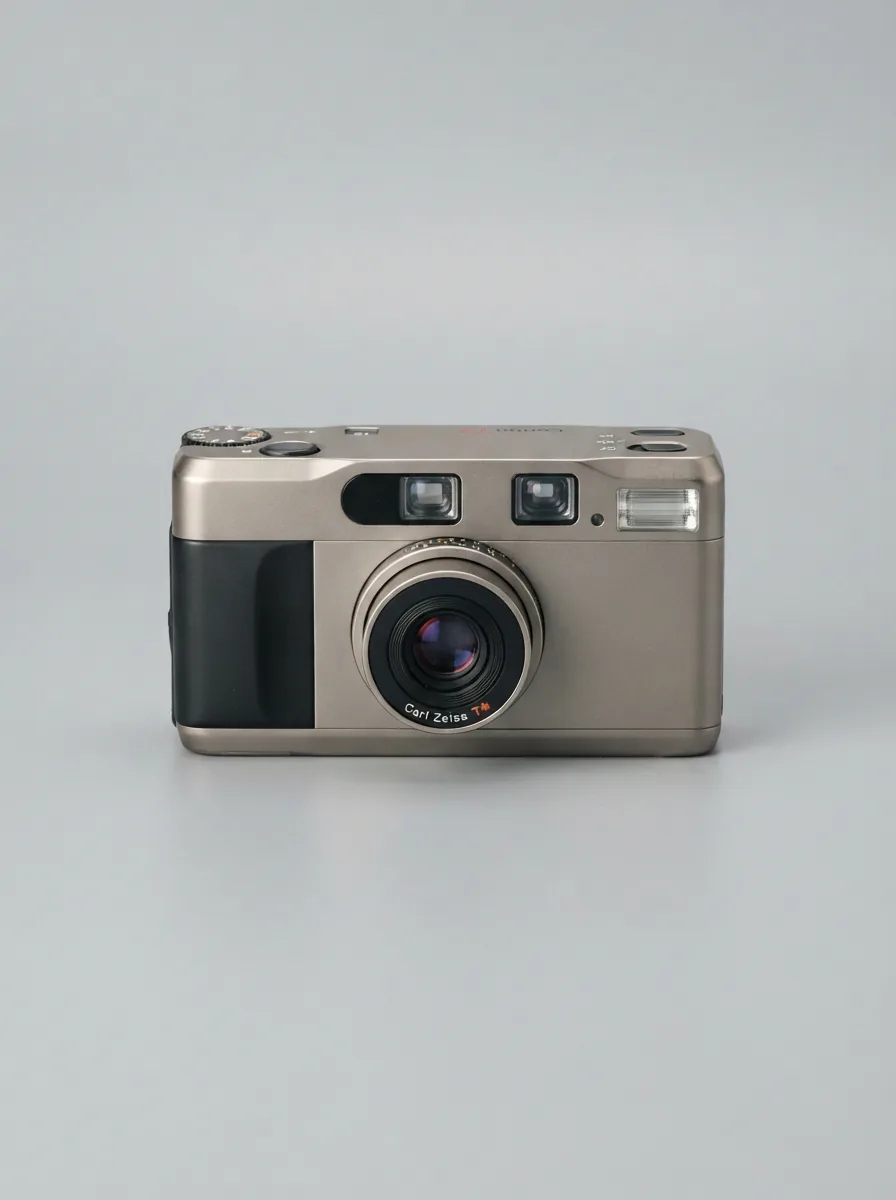
1. Contax T2 — Titanium Silver
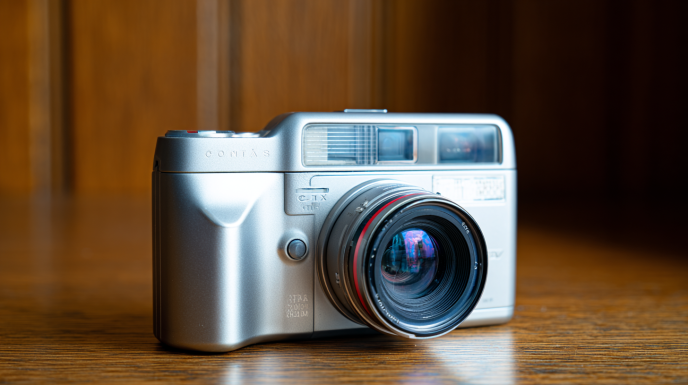
The definitive version of this iconic camera. The standard titanium silver Contax T2 is the most recognized and widely owned expression of the T-series philosophy: a precision-built, autofocus 35mm compact housing a Carl Zeiss Sonnar T* 38mm f/2.8 lens, built-in flash, manual aperture control, and exposure compensation. Near-mint examples sourced from Japan remain the gold standard of pre-owned collectible compact cameras, combining genuine working capability with appreciating collector value.
- Expert Rating: ★★★★½ (4.5/5) — consistent across multiple independent expert reviews
- Price Range: From €1,439.99 (Analogue Shop); eBay tested examples range approximately $900–$1,500 USD depending on condition
2. Contax T3 — Titanium Silver
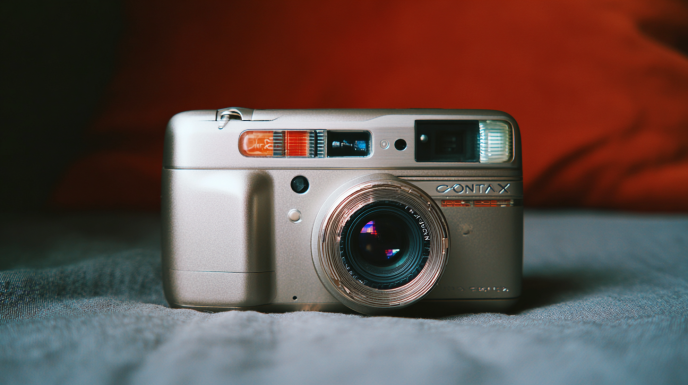
The T2’s spiritual successor elevates every dimension of the already-formidable formula. The Contax T3 features a redesigned Carl Zeiss Sonnar 35mm f/2.8 lens widely considered even sharper than the T2’s, an enlarged and more legible viewfinder, and a refined control layout. Rarer than the T2 and produced in smaller numbers, it commands a significant premium that reflects both its optical supremacy and its scarcity. Among working photographers and collectors, the T3 is frequently described as the finest 35mm point-and-shoot camera ever manufactured.
- Expert Rating: ★★★★★ (5/5)
- Price Range: From €2,799.99 (Analogue Shop); frequently exceeds $2,500 USD for good examples on eBay
3. Contax T2 — Gold Edition
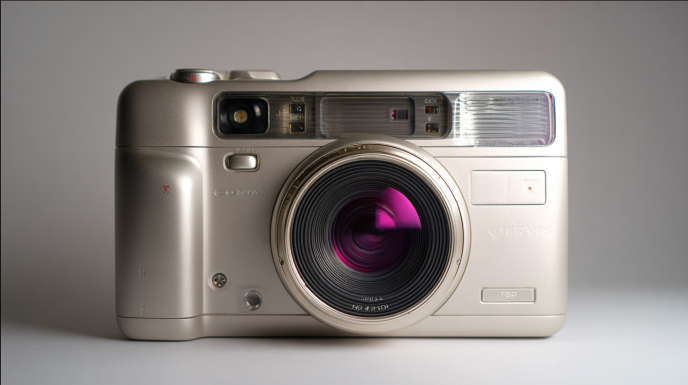
For photographers who find the silver titanium body insufficiently distinguished, the Contax T2 Gold Edition offers a warm, luxurious alternative. Functionally identical to the standard T2 in every operational respect, this limited-edition colorway has become a collector’s favorite whose relative scarcity pushes market values meaningfully above the standard version. It functions as an exceptional gift, a display-worthy collectible, and a genuinely capable working camera simultaneously — a combination that almost no other object in photography can claim.
- Expert Rating: ★★★★½ (4.5/5)
- Price Range: From €1,679.99 (Analogue Shop); eBay examples in excellent tested condition range from $1,000 to $1,700+ USD
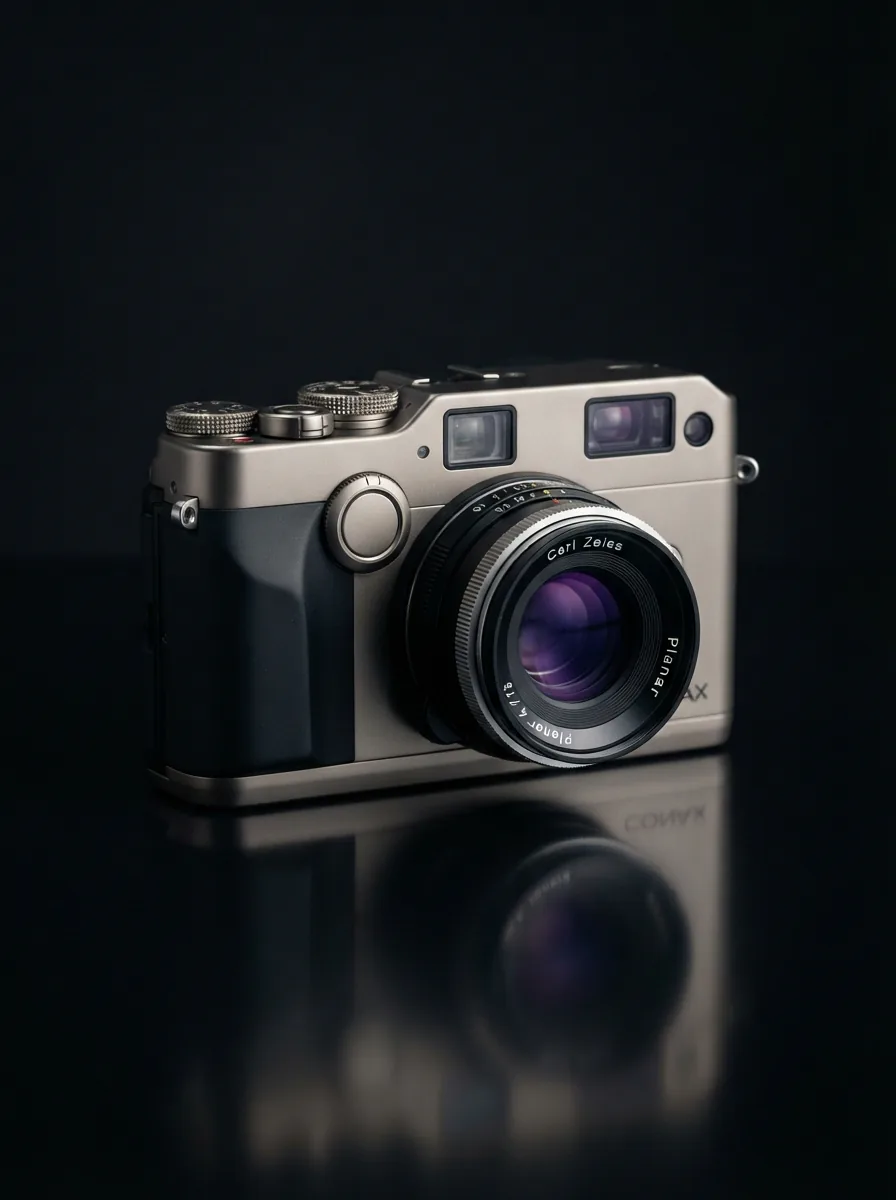
4. Contax G2

The Contax G2 represents a fundamentally more serious — and system-capable — expression of the Contax philosophy. This autofocus rangefinder accepts a full family of interchangeable Carl Zeiss T* lenses and delivers image quality that directly challenges dedicated Leica M setups. Favored by advanced amateur and professional photographers who want the Zeiss optical advantage without the manual-focus demands of traditional rangefinders, it is one of the most capable film camera systems ever produced and remains actively sought on the secondhand market.
- Expert Rating: ★★★★★ (5/5) among advanced shooters
- Price Range: From €2,199.99 (Analogue Shop)
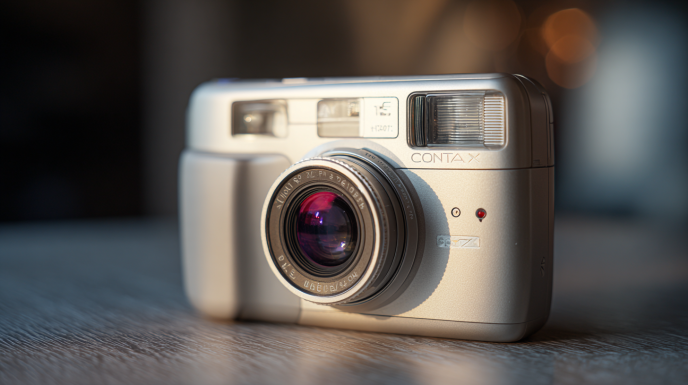
5. Contax T VS (Vario Sonnar)

An often-overlooked gem in the Contax compact lineup, the Contax T VS features a Carl Zeiss Vario-Sonnar T* zoom lens, offering compositional flexibility that the fixed focal lengths of the T2 and T3 cannot provide. At a significantly lower price point than its fixed-lens siblings, it delivers genuine Zeiss optical quality for photographers who prize versatility, or for those drawn to the T-series experience but finding the T2’s current market pricing prohibitive. An excellent entry point into the world of premium compact film photography.
- Expert Rating: ★★★★ (4/5)
- Price Range: From €599.99 (Analogue Shop)
A Camera Born from Uncompromising Standards
To understand why the Contax T2 commands the prices it does — and why those prices have remained stubbornly elevated even as photographic trends have shifted and the broader economy has fluctuated — you must understand the conditions and philosophy of its creation. Kyocera’s Contax division launched the T2 in 1990 as an explicitly premium answer to the disposable and near-disposable compact cameras dominating the consumer market of that era. The product brief was, by all accounts, to produce the finest compact 35mm camera in the world, without compromise in material, optics, or execution.
That brief was honored in every observable detail. The titanium body is not merely cosmetic branding. Titanium’s combination of extreme hardness, exceptional lightness relative to its strength, and resistance to corrosion makes it the ideal material for a camera intended to travel the world across decades. Long-term owners consistently report that their T2 bodies, carried for years across continents and climates ranging from tropical humidity to mountain cold, emerge from those experiences with little more than the expected patina of use. That is a durability claim that few electronic devices of any era can honestly make.
The tactile quality of the controls reinforces the same standard. Aperture rings click with mechanical precision, focus wheels operate with damped smoothness, and the lens extension and retraction mechanism — one of the T-series’ most characteristic design features — moves with a satisfying, jewel-like authority. Even the battery cover, a milled disc of solid metal rather than the hollow plastic tab found on lesser cameras, signals the philosophy that governed every manufacturing decision. Photographer and five-year T2 user Laura Odermatt describes the first impression with economy and accuracy: “From the first touch, the T2 felt so premium — it has a durable titanium body, clicky apertures, and a smooth focus wheel. Nothing about it feels plasticky or cheap.”
The Carl Zeiss Sonnar Lens: Where Excellence Lives
If the titanium body is the Contax T2’s armor, then the Carl Zeiss T* Sonnar 38mm f/2.8 lens is its soul. This five-element optical formula — featuring Zeiss’s proprietary T* anti-reflective multi-coating applied to each element — is responsible for the images that have made this camera famous across five decades of photographic culture, and it is the single most important reason to choose the T2 over its many competitors at any price level.
The Zeiss Sonnar renders images with outstanding color fidelity, natural contrast, and exceptional central clarity. Vignetting exists but remains subtle, and most experienced film photographers consider it a welcome contributor to the organic, authentically analog quality of the results rather than a flaw requiring correction. Chromatic aberration is minimal. The rendering sits in a precise and flattering middle ground — neither clinical and flat like some digital-era corrected lenses, nor excessively soft in the way that characterizes cheaper vintage optics. It suits portraiture, street photography, travel documentation, and architectural work with equal credibility.
Aaron Stennett, writing for Casual Photophile after shooting the T2 extensively across Italy and during England’s 2018 World Cup summer, offered this assessment: “The Carl Zeiss Sonnar 38mm F/2.8 with T* coating of the Contax T2 is a five-element optic that provides outstanding color rendition and clarity. The lens delivers medium contrast negatives with only a hint of vignetting and no major aberrations to speak of. This results in organic images bursting with character.”
The most striking endorsement of the T2’s optical performance comes from a direct side-by-side comparison conducted during Stennett’s Italian trip. He shot the T2 alongside a Leica M4 equipped with a Carl Zeiss ZM 35mm f/2.8 — a lens that costs multiples of the T2’s entire asking price when purchased separately and represents one of the finest optical instruments in modern film photography. His conclusion was unambiguous: “What was surprising was just how closely the Contax matched the image quality from this much larger Leica kit.” This is not hyperbole. It is a considered professional judgment, and it is one echoed by experts across the review landscape.
The 38mm focal length is a deliberate and thoughtful choice that contributes significantly to the camera’s practical versatility. Sitting between the traditional 35mm wide-angle and the 40mm near-standard perspective, it offers a natural, slightly generous field of view that suits candid photography, environmental portraiture, and street work with equal ease. It is wide enough to incorporate context and atmosphere into a frame, tight enough to create genuine intimacy with subjects. For photographers accustomed to the more demanding depth-of-field management required by longer focal lengths, the T2’s 38mm offers a forgiving and rewarding compositional latitude.
The Shooting Experience: Practical Authority in the Field
Loading the T2 is as effortless as the camera’s design philosophy implies. Film loading is fully automatic — insert the canister, draw the leader across to the take-up spindle, close the back, and the camera advances to the first frame independently. The LCD panel confirms the loaded frame count, and you are ready to work.
In standard operation, the T2 functions in Program mode, where its evaluative metering system selects both aperture and shutter speed based on ambient light. The metering is accurate and responsive across a wide tonal range. The autofocus system, utilizing phase detection technology, is quick and decisive in good light. Half-pressing the shutter button locks focus and holds that lock while the photographer recomposes — a feature standard on contemporary cameras but genuinely uncommon on compact film cameras of the T2’s era, and one that provides a significant practical advantage over many of its class competitors.
The manual control suite gives the T2 a dimension of creative authority that most point-and-shoot cameras of any era simply do not offer. Selectable manual apertures, exposure compensation of ±2 EV in 0.5 EV increments adjustable frame by frame, and zone manual focus distances of 0.7m, 1m, 2m, 5m, and infinity collectively enable a degree of creative intentionality that transforms this camera from a passive recorder into an active photographic instrument. The exposure compensation function is particularly valuable for photographers working with unconventional film stocks, shooting in high-contrast lighting environments, or deliberately pursuing non-standard tonal interpretations.
One important technical characteristic requires clear explanation: selecting f/2.8 on the aperture ring activates program mode, not a locked wide-open aperture. The camera will expose at f/2.8 when light conditions permit it to do so, but in brighter environments it will stop down automatically to maintain correct exposure. Any other aperture value selected on the ring functions as true aperture priority. This behavior is a deliberate aspect of the T2’s design and is well-documented in expert literature. It can surprise photographers expecting SLR-style aperture-priority behavior from f/2.8, but experienced shooters adapt quickly and most find it unproblematic in practice.
The built-in flash, operated via a dedicated manual switch rather than an automatic pop-up trigger, offers two modes: standard direct flash and a dual-preflash red-eye reduction option. The manual engagement requirement gives the photographer conscious creative control over flash use — a meaningful distinction from cameras that fire flash automatically based solely on metering data. Flash photography on the T2 produces the characteristic high-contrast, subject-spotlighting results that have defined an entire aesthetic within contemporary film photography, and the camera handles both flash and available-light work with equal technical confidence.
A Balanced Assessment: What Experts Caution
No camera earns a balanced expert assessment without honest acknowledgment of its limitations, and the Contax T2’s reviewers are consistent on several points that prospective buyers must weigh carefully.
The viewfinder is genuinely small — multiple expert reviewers identify this as the camera’s most significant ergonomic shortcoming. It requires precise eye alignment to see the complete frame and all informational LED displays simultaneously, and photographers who wear eyeglasses will find this particularly demanding. The information it presents — shooting mode, flash status, shutter speed indicators, focus-lock confirmation, and the low-speed “L.T.” warning — is useful when visible, but its utility is meaningfully limited by the viewfinder’s physical dimensions. This is a real compromise in an otherwise exemplary camera, and potential buyers should be aware of it before committing.
Low-light performance requires managed expectations informed by the camera’s specifications. When ambient light drops to a level requiring shutter speeds below 1/30 second, the “L.T.” indicator illuminates in the viewfinder. Handheld shooting at these speeds on 35mm film will produce motion blur in most circumstances. The ±2 EV exposure compensation and the availability of fast modern film stocks mitigate this limitation, but it cannot be eliminated entirely.
Repair availability and associated cost constitute the T2’s most significant long-term risk factor for buyers. The T2 is a fully electronic camera — there are no mechanical fallback systems. When electronics fail, qualified technicians with the expertise and parts necessary to service T-series Contax cameras are rare, and their services are not inexpensive. Buyers are strongly advised to purchase from reputable specialist dealers who have thoroughly tested their examples, and to seek out sellers offering a warranty period. The alternative — purchasing an untested example at a discount — carries meaningful financial risk.
Price, Value, and the Investment Argument
The Contax T2’s price history is instructive in its own right. When Kendall Jenner was filmed using the camera on American primetime television in 2017, the T2’s already-elevated secondhand market values increased substantially within weeks. At peak demand, mint-condition silver examples traded at $1,300 or more, with black and limited-edition versions commanding significantly higher premiums. Markets have since moderated, but excellent-condition working examples consistently list between $900 and $1,500 USD on eBay, with unused Japanese-market examples frequently exceeding $2,000.
The investment framing is not merely rhetorical positioning. Limited-edition variants — the 60 Years Anniversary, the Gold, the Titanium Black, the Platinum — have appreciated substantially and continue to attract collector premiums that outpace inflation by a meaningful margin. Even standard silver examples have held their value far more reliably than virtually any other consumer electronics product of comparable age, a reflection of genuine material quality, optical irreplaceability, and the cultural permanence that film photography has demonstrated in the digital era.
For photographers who use the T2 as an active working tool — as a travel companion, an everyday creative instrument, or a resource for professional and editorial shoots — the cost-per-use calculation often resolves more favorably than the headline price suggests. A camera that accompanies every significant journey and life event for a decade of serious use becomes, in practice, among the most cost-effective tools in a working photographer’s collection.
Technical Specifications
The Contax T2 is a 35mm format point-and-shoot film camera with a fixed retractable Carl Zeiss T* Sonnar 38mm f/2.8 lens and a five-element optical construction. Shutter speeds range from 1 second to 1/500 second, with bulb mode capability. The minimum focusing distance is 0.7 meters. Body weight is approximately 295 grams without battery. The camera is powered by a single 3V CR123A lithium battery. Special features include a built-in flash with red-eye reduction preflash option, exposure compensation of ±2 EV in 0.5 EV increments adjustable frame by frame, autofocus with manual focus zone option, a 10-second self-timer, and a titanium alloy body construction. The T2 was manufactured by Kyocera Corporation, Japan, with optics supplied and branded by Carl Zeiss, Germany.
Conclusion: The Standard by Which Others Are Measured
The Contax T2 is, without serious contest, one of the greatest compact film cameras ever manufactured. Its titanium construction, its Zeiss optics, its considered blend of automatic convenience and manual creative control, and its demonstrated longevity across decades of real-world use collectively place it in a category that very few competitors have entered and none have convincingly surpassed. Expert opinion, market behavior, and the testimony of photographers who have carried these cameras across years of meaningful work all point toward the same conclusion.
Is it expensive? By any objective historical standard for compact cameras, yes — emphatically. But price and value are different calculations. The value of an instrument that produces beautiful images reliably, feels exceptional in the hand, documents life’s most important moments with honesty and craft, and retains — or appreciates — in monetary worth over time is not captured in a unit-cost analysis. The Contax T2 is rare among photographic tools in that it satisfies on every one of these dimensions simultaneously and without meaningful compromise.
For the serious photographer seeking a compact, capable, and beautifully built 35mm companion — one that produces genuinely great images, earns the trust required for professional and personal work alike, and has the material quality to last for decades — the Contax T2 remains the benchmark against which everything else in its category is honestly measured. Source yours from a reputable specialist, shoot it with intention, and care for it accordingly. This is one investment that reliably delivers in every sense of the word.