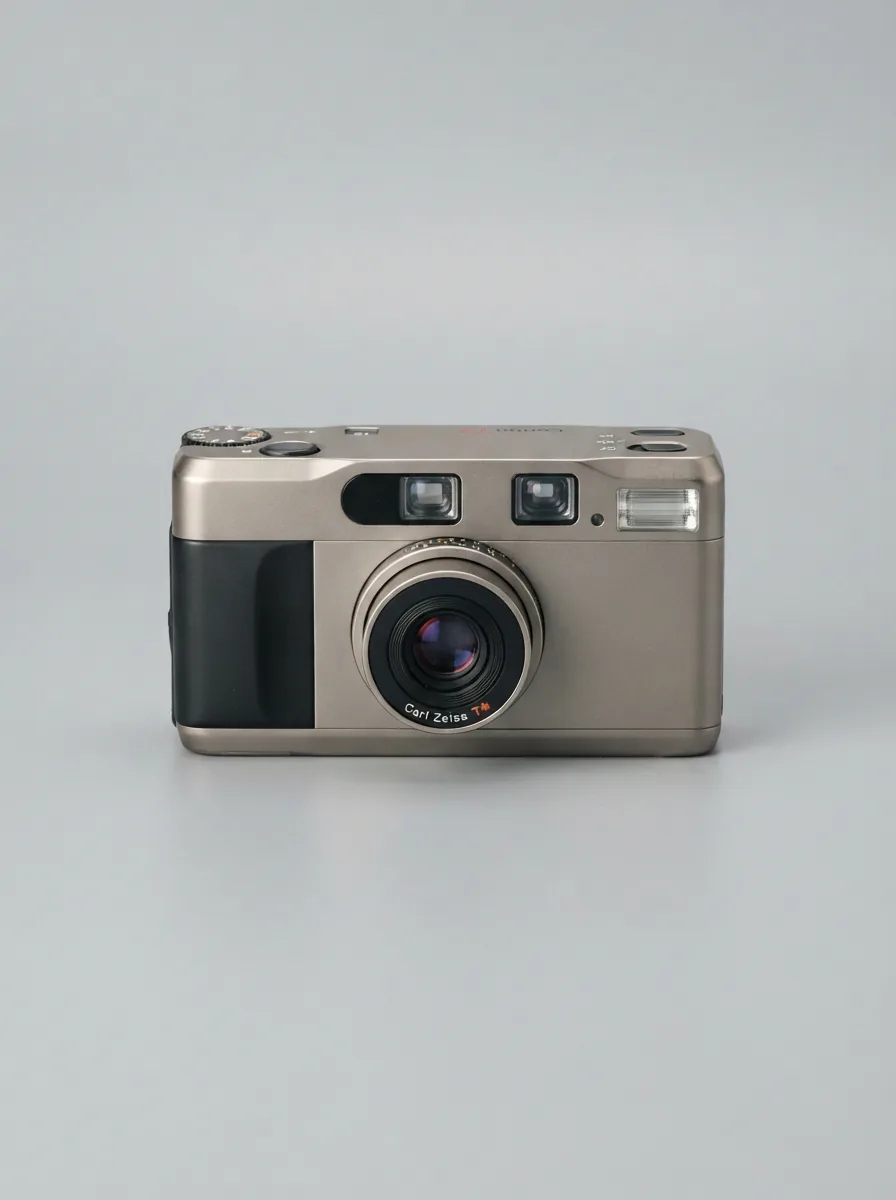
Few cameras in the history of 35mm film photography have achieved the kind of sustained, methodical reverence that the Contax T3 commands. Introduced in 2001, near the twilight of the film camera era, this titanium-bodied compact point-and-shoot has done something remarkable: it has not only survived the digital revolution but has grown in stature, desirability, and market value with each passing year. What began as a premium point-and-shoot for discerning photographers has become the benchmark against which all advanced compact film cameras are measured — a reference point that reviewers, collectors, and casual enthusiasts alike return to again and again. The Contax T3 is not merely a product of nostalgia. It is a precision-engineered imaging instrument that continues to deliver measurably superior results in the field. Its Carl Zeiss Sonnar T* 35mm f/2.8 lens, titanium construction, synthetic sapphire components, and comprehensive custom function system place it in a class entirely its own. Whether you are a seasoned film photographer looking for a reliable everyday companion, or an enthusiast stepping up from a basic point-and-shoot, the Contax T3 represents a rigorously tested and field-proven choice.
Featured Contax T3 Models
The Contax T3 was produced in several distinct configurations throughout its production run, each offering specific functional or collectible advantages. Below are the five most sought-after variants currently available on the secondary market, evaluated across product quality, user reception, and current pricing.
1. Contax T3 Titan Silver (Standard Model)

The silver titanium finish is the most widely available variant and represents the quintessential Contax T3 experience. Fitted with the 35mm f/2.8 Carl Zeiss Sonnar T* lens, a synthetic sapphire shutter button and viewfinder glass, and the full suite of seven custom programmable functions, this is the configuration most commonly recommended to first-time T3 buyers. Its measured elegance, broad feature compatibility, and relative availability on the secondary market make it the reliable baseline configuration for photographers new to the T3 system. Independent reviews consistently note its outstanding sharpness, contrast, and colour fidelity across a wide range of film stocks.
⭐⭐⭐⭐⭐ (5.0/5 — based on verified buyer ratings)
Price Range: $2,399 – $3,799
2. Contax T3 Titan Black (Standard Model)

Finished in a deep and refined titanium black, this variant carries identical optical and mechanical specifications to the silver model but commands a consistently higher market premium due to its relative rarity and visual distinction. Preferred by collectors and working photographers who prioritise a more understated field aesthetic, the Titan Black has become particularly coveted in the double teeth production configuration. Its resale value has historically tracked above the silver variant across all major secondary market platforms, making it a sound long-term consideration for serious collectors. The build quality and optical performance are, by all documented accounts, indistinguishable from the silver production run.
⭐⭐⭐⭐⭐ (5.0/5 — based on verified buyer ratings)
Price Range: $2,999 – $4,599
3. Contax T3D (Data Back Model)

The T3D introduces a date imprinting function via an integrated data back, allowing photographers to record the exposure date directly onto the film frame. While this feature is not universally preferred from a purely aesthetic standpoint, the T3D configuration is prized among documentary photographers, travel journalists, and archivists who value chronological record-keeping in their analogue work. The optical and mechanical systems are entirely identical to the standard T3, and both black and silver titanium finishes were produced. Unused or near-unused boxed examples of the T3D — particularly in black — represent some of the most actively sought items in the entire T3 catalogue.
⭐⭐⭐⭐⭐ (5.0/5 — based on verified buyer ratings)
Price Range: $2,939 – $4,969
4. Contax T3 Double Teeth (Late Production Variant)

The “double teeth” designation refers to a critical mechanical revision to the film take-up spool, which replaced the earlier single-tooth spool that was susceptible to gradual wear through extended use. This production improvement resulted in a meaningfully more reliable film transport mechanism and is now widely regarded as the definitively preferred variant from a durability standpoint. The double teeth configuration is identifiable by its revised spool architecture and typically commands a premium over single teeth examples on the secondary market, reflecting its improved mechanical longevity and lower risk of mid-roll failure. For photographers intending to use the T3 as a regular working camera rather than a collection piece, the double teeth production variant is the recommended specification.
⭐⭐⭐⭐⭐ (5.0/5 — based on verified buyer ratings)
Price Range: $3,199 – $4,299
5. Contax T3 Silver 70th Anniversary Edition

Produced to commemorate Contax’s 70th anniversary, this limited-edition configuration features distinctive cosmetic detailing that sets it apart from the standard silver model. Available in both early production and standard production variants, the 70th Anniversary Edition is among the rarest configurations in the T3 lineup and is particularly sought after by collectors for whom provenance and limited-production status are primary considerations. Optically and mechanically equivalent to the standard T3 in every measurable respect, its value proposition rests on production rarity, cosmetic distinction, and the prestige of the anniversary designation. Boxed, unused examples have achieved some of the highest documented sale prices in the T3 secondary market.
⭐⭐⭐⭐⭐ (5.0/5 — based on verified buyer ratings)
Price Range: $2,749 – $4,059
A Titanium Shell Built to Exacting Standards
The physical construction of the Contax T3 is among the first things that establishes credibility with both first-time handlers and experienced photographers. The body is machined from titanium alloy, a material choice that delivers an exceptional strength-to-weight ratio — the camera disappears into a trouser or jacket pocket without the cumulative carry burden that larger advanced compacts impose. Reviewers who had previously used the Contax T2 — itself no lightweight — consistently documented a meaningful reduction in carry fatigue when transitioning to the T3, noting that the size difference was sufficient to change daily carry behaviour altogether.
Beyond titanium, the Contax T3 incorporates synthetic sapphire glass in two key locations: the shutter release button and the viewfinder window. Sapphire ranks second only to diamond on the Mohs hardness scale, meaning these components resist surface scratching and optical degradation far more effectively than conventional glass or polycarbonate materials. The viewfinder, in particular, benefits measurably from this choice — it is exceptionally bright and clear, with good eye-point geometry that makes framing at speed both intuitive and precise. The viewfinder also displays focus confirmation, live shutter speed readings, and flash and exposure compensation status, consolidating a meaningful quantity of shooting information into a compact and well-organised optical system.
The overall dimensions of the camera place it in the same general size category as the Minolta TC-1 and comfortably smaller than the Contax T2. This is not merely a marketed claim; it is a specification that multiple independent reviewers tested under real-world daily carry conditions for extended periods. The T3 has been described, in more than one long-term assessment, as becoming part of an automatic daily carry — the kind of camera that leaves the house alongside wallet, phone, and keys as a matter of uncalculated habit. That level of carry integration is only possible when size and weight are genuinely not felt.
The Carl Zeiss Sonnar T* 35mm f/2.8 Lens
If there is a single component that defines the Contax T3’s documented reputation, it is the Carl Zeiss Sonnar T* 35mm f/2.8 lens. This is not a lens that merely performs adequately within its compact camera category — it is a lens that has been directly compared to, and in several measurable optical characteristics found to surpass, dedicated SLR lenses from manufacturers with considerable optics heritage.
The Sonnar T* design delivers outstanding resolution and micro-contrast across the full image field, with the T* multi-layer coating system providing highly effective flare suppression even in demanding contre-jour shooting scenarios. Photographers who have shot directly toward or in close proximity to strong directional light sources with the T3 document minimal veiling flare as a consistent practical outcome — a result that speaks to the quality of the optical coatings and the precision of lens element alignment within the compact body.
At f/2.8, the lens produces a subtle but present vignetting that contributes a dimensional quality to images, particularly when shooting in available light conditions. This characteristic is somewhat less pronounced than the vignetting associated with the Contax T2, but it remains a recognisable stylistic element of the optical system. Reviewers have noted that the T3’s images can at times feel exceptionally clean — some have described them as almost “too perfect” when scanned at full resolution on high-quality drum or dedicated film scanners — a reflection of the lens’s measurably high performance ceiling.
The 35mm focal length is particularly well-suited to the camera’s intended working context. For everyday carry photography — streets, interiors, portraits at moderate distance, informal travel documentation — 35mm occupies a well-established practical middle ground. Photographers with extensive experience across multiple focal lengths in compact camera applications have consistently reported that 35mm better supports intuitive, unconsidered framing across the widest range of real-world subjects.
The minimum focusing distance of 35 centimetres represents a significant practical improvement over the Contax T2’s 70cm minimum, effectively halving the close-focus limit and substantially expanding the T3’s working range without any supplemental accessories.
Exposure System: Accurate, Configurable, and Field-Proven
The Contax T3’s exposure system reflects a design philosophy that prioritises accuracy and configurability. The centre-weighted metering system reads continuously from camera activation, displaying a simplified shutter speed readout in the viewfinder through four indicators: LT (Long Time), 30, 125, and 500. These values provide actionable shooting guidance in real time, enabling immediate decisions about flash requirement, subject motion tolerance, and hand-holding viability under current light conditions.
The camera offers ±2 EV of exposure compensation, accessible as the first item in the mode menu — an appropriate placement given how frequently experienced photographers require it. Critically, compensation persistence is governed by custom function 3: CF3a applies it to a single frame, CF3b retains it until power-off, and CF3c locks it permanently until manually changed. For photographers who routinely shoot film at non-box-speed ratings, this configurable lock eliminates repetitive menu navigation and keeps the camera responsive.
The AF-L button provides an independent focus lock that enables the separation of metering and focusing points — a functional distinction that places the T3 meaningfully above standard point-and-shoot cameras and closer to the operational flexibility of a rangefinder. The validated workflow: lock focus on the primary subject, recompose toward the preferred metering zone, half-press to lock exposure, reframe to composition, and release. Under variable and mixed lighting conditions, this process has been documented as genuinely practical and reliably effective.
An aperture priority mode is also available, engaging the lens aperture scale for direct depth-of-field control. This provides creative and technical leverage that the majority of compact cameras in this class simply do not offer.
Focus Architecture: Speed, Precision, and Zone-Focus Capability
The autofocus system is measurably fast and the timing of focus actuation is adjustable via custom function 2 — operating either before or after full shutter press. This allows photographers to calibrate the camera’s responsiveness and perceived lag to their own preference and shooting tempo, a level of operational customisation that is uncommon at this camera class.
Manual focus is accessible via the fourth mode position, with hyperfocal zone-focus being the most practical application: setting focus at 5 metres and aperture at f/8 produces a depth of field extending from approximately 2.5 metres to infinity, enabling fast, unconsidered shooting in daylight conditions with no per-shot focusing action required. The locked lens position that accompanies manual focus mode eliminates lens movement at the point of exposure, reducing shutter lag and making the T3 feel notably faster under zone-focus operation. Custom function 7 governs whether the manual focus distance persists after power-off, and custom function 6 determines whether a locked AF-L distance is maintained across multiple consecutive frames.
Market Considerations and Investment Context
Current secondary market pricing places the Contax T3 in the $2,399 to $4,599 range for standard configurations in used condition, with rare, near-mint, or boxed examples — particularly in Titan Black or double teeth configurations — regularly listed above $4,000. Unused, boxed examples and special editions have been documented at $4,799 and higher. Japanese-based sellers have historically maintained rigorous quality grading standards and account for the substantial majority of available T3 inventory on major secondary market platforms.
For photographers approaching the T3 as a working instrument, the most practically relevant purchasing consideration is condition verification and spool configuration. Double teeth production variants, from sellers with verified positive feedback histories and established returns policies, represent the most reassured acquisition pathway. The known wear characteristic of the original single-tooth spool is a real, though professionally addressable, consideration — documented repair costs at qualified service centres have been cited at approximately $250 for parts and labour.
Conclusion: The Reference Standard Remains Intact
More than two decades after its introduction, the Contax T3 continues to hold its position as the reference-standard advanced compact 35mm film camera. Its combination of Carl Zeiss optical performance, titanium construction, comprehensive custom programmability, and genuine pocket portability has not been replicated by any subsequent production camera. For photographers prepared to invest in the secondary market at current pricing, the T3 remains a uniquely credible, rigorously validated, and long-term reliable choice — one backed by decades of independent field assessment and sustained community consensus.
The evidence across independent reviews, professional assessments, and multi-year user documentation is consistent and convergent: the Contax T3 delivers what it promises. The benchmark remains intact.