There is something deeply compelling about a camera that the internet has spent thirty years misunderstanding. In a film photography landscape dominated by social media hype and inflated point-and-shoot prices, the Contax G1 Green Label has quietly become one of the most fascinating chapters in the revival of analog culture — a piece of precision engineering that blurs the line between collector’s trophy, street photographer’s workhorse, and cult aesthetic object all at once. TIME magazine once described the original Contax G1 as “a thoroughly modern version of the classic Leica, proof that retro is the wave of the future” — and if anything, that assessment has only grown more accurate with time. The Green Label variant, in particular, represents the most capable and versatile version of this legendary 35mm rangefinder, unlocking access to an expanded family of Carl Zeiss G-mount lenses that transforms the system from a capable compact into a full creative platform. Whether you are a seasoned film photographer drawn to the Zeiss rendering, or a newcomer seduced by the titanium shell and the analog aesthetic, the Contax G1 Green Label is one of the rare cameras that delivers on every dimension of the conversation surrounding it.
Featured Products: Top 5 Contax G1 Green Label Picks
Before exploring what makes this camera so culturally resonant and technically impressive, here is a curated look at the five most popular Contax G1 Green Label configurations available on the market today.
- Contax G1 Green Label — Body Only: The entry point into the G system. The titanium-finished aluminum body ships without a lens, giving you the freedom to build your own kit around your preferred focal length. Features the full autofocus system, optical viewfinder with approximately 0.6x to 0.7x magnification, and the clean, minimal design that has made the G1 iconic. Ideal for photographers who already own G-mount glass or are assembling a kit piece by piece. Rating: ★★★★☆ (4.5/5) — Price Range: $400–$600.

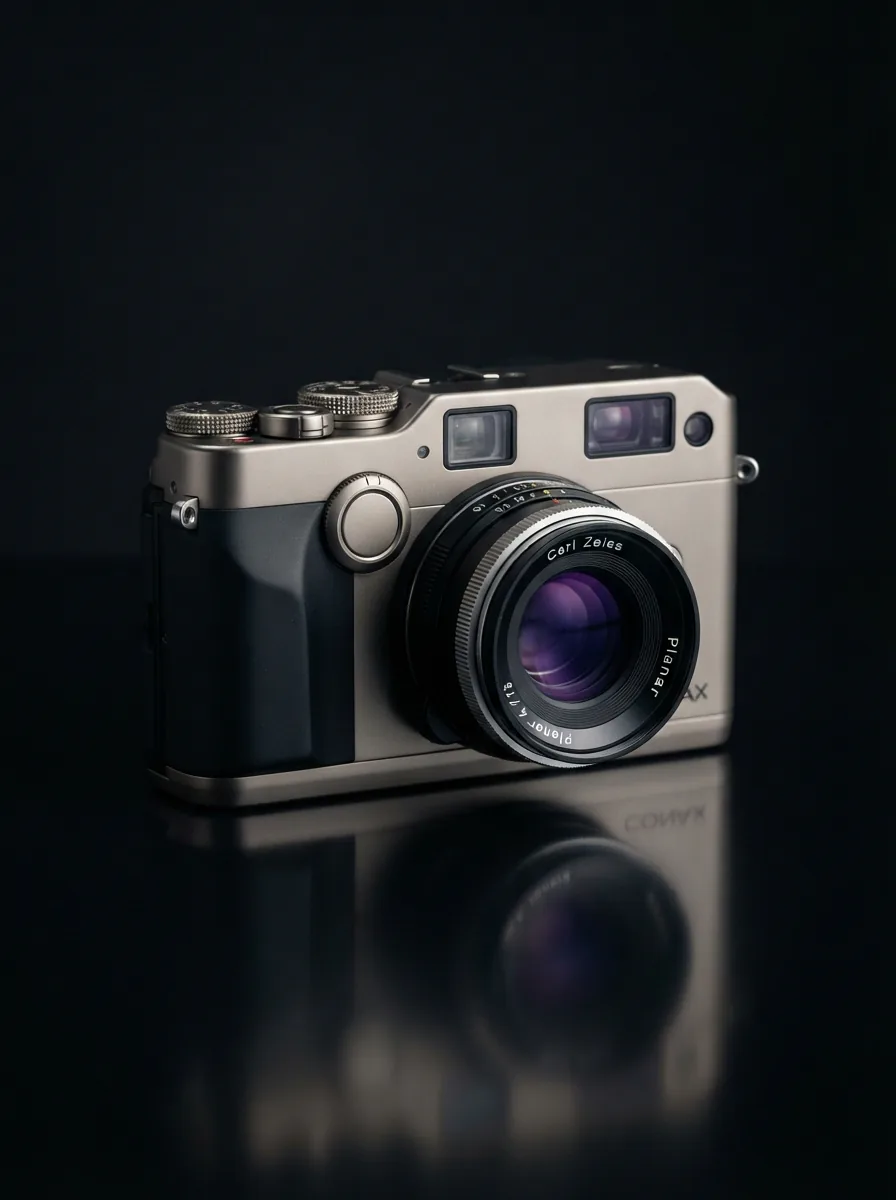
- Contax G1 Green Label + Carl Zeiss Planar T* 45mm f/2: The definitive pairing. The 45mm Planar T* f/2 is widely regarded as the sharpest and most balanced lens in the G-mount lineup, offering a near-standard field of view with remarkable micro-contrast and beautiful wide-open rendering. This combination is consistently the most sought-after configuration on the secondhand market and represents the full G1 experience as Contax originally intended it. Rating: ★★★★★ (5/5) — Price Range: $950–$1,100.

- Contax G1 Green Label + Carl Zeiss Biogon T* 28mm f/2.8: A favorite among street photographers and travelers. The 28mm Biogon f/2.8 delivers stunning edge-to-edge sharpness with minimal distortion — a hallmark of Zeiss’s legendary Biogon optical formula. The wider field of view suits candid, environmental, and documentary work beautifully, and experienced users frequently cite it as an underrated companion that rivals the 45mm in image quality. Rating: ★★★★★ (5/5) — Price Range: $800–$900.

- Contax G1 Green Label + Carl Zeiss Sonnar T* 90mm f/2.8: For portrait and detail-oriented work, the 90mm Sonnar f/2.8 brings elegant compression and creamy background separation to the G1 system. Results from well-matched body-and-lens combinations can be spectacular, with panoramic and portrait images producing a level of detail that has been compared favorably to medium format results. Rating: ★★★★☆ (4/5) — Price Range: $540–$700.

- Contax G1 Green Label 3-Lens Kit (28mm + 45mm + 90mm) + TLA140 Flash: The collector’s dream and the working photographer’s complete system. The 3-lens kit combines the Biogon 28mm, Planar 45mm, and Sonnar 90mm alongside the dedicated TLA140 external flash — covering virtually every shooting scenario from wide environmental documentary work to intimate portrait sessions. Complete kits in excellent condition are increasingly rare and command strong premium prices on the secondhand market. Rating: ★★★★★ (5/5) — Price Range: $1,600–$1,950.

A Camera Born Ahead of Its Time
To understand why the Contax G1 Green Label holds such a unique position in today’s film photography revival, you need to appreciate the world it was designed for. The year was 1994. Japanese corporate giant Kyocera — the parent company behind both Contax and Yashica — released the G1 as a genuinely bold proposition: the optical performance of Carl Zeiss glass wrapped in a compact, rangefinder-style body with the modern convenience of an autofocus interchangeable lens system. At launch, the camera cost over $2,000, positioning it squarely in professional and serious enthusiast territory and signaling Kyocera’s intent to attract photographers who demanded both performance and elegance in the same package.
The G1 occupied a fascinating intersection in Contax’s broader product universe. Before it came the Contax T (1984) and Contax T2 (1991) — beloved fixed-lens point-and-shoots that remain among the most sought-after compact cameras in the world. After it came the Contax G2 (1996), a more refined and feature-complete evolution with improved autofocus performance, faster maximum shutter speeds of 1/6000th of a second, and a broader lens compatibility range. But nestled between these two landmark cameras, the G1 carved its own identity: a camera that democratized the G-mount system without compromising the design integrity or optical pedigree that made Contax a special name.
The Green Label designation is at the heart of the G1’s story. On the original “Silver Label” G1 bodies, the film loading instructions decal inside the camera was silver — and the body’s internal firmware was limited to four core G-mount lenses: the ultra-wide 16mm f/8, the 28mm f/2.8 Biogon, the 45mm f/2 Planar, and the 90mm f/2.8 Sonnar. The Green Label version features a green film loading decal and, more importantly, updated firmware that unlocks compatibility with two additional lenses originally designed for the G2: the 21mm f/2.8 Biogon and the coveted 35mm f/2 Planar. For photographers who want the most expansive coverage or the cinematic wide-open rendering of the 35mm f/2, the Green Label is not simply preferable — it is essential. Some G1 bodies received the Green Label designation directly from Contax technicians as a factory upgrade, while others were modified through a ROM reprogramming process that has become well-documented in film photography communities.
Build Quality That Transcends Its Era
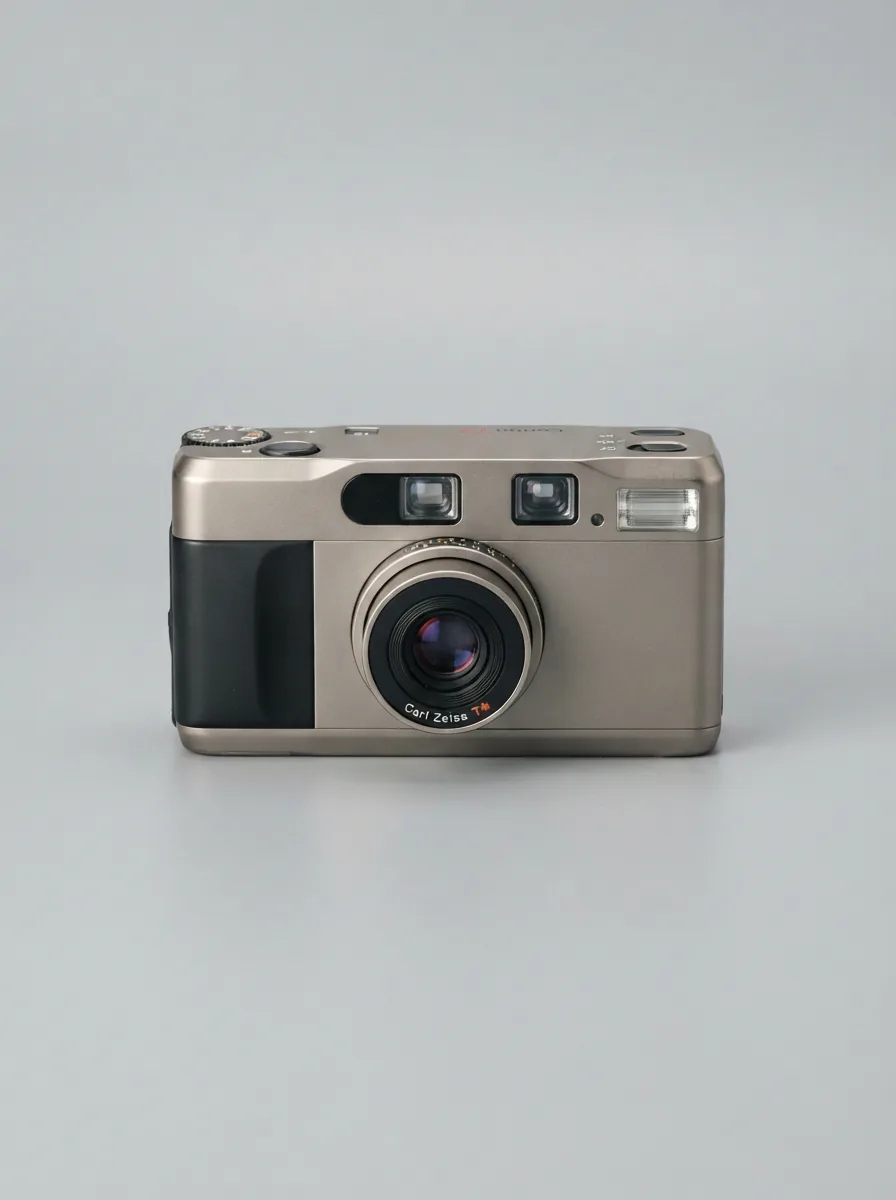
Pick up a Contax G1 Green Label for the first time and the reason for its enduring appeal is immediately tangible. The body is constructed on an aluminum frame and finished with a characteristic titanium exterior — materials that give it a weight and rigidity that most film cameras of the 1990s simply cannot match. It sits in the hand with the authority of a precision instrument rather than a consumer product, and that distinction matters enormously in a secondhand market where plastic-bodied cameras from the same era are now commanding prices driven almost entirely by nostalgia and scarcity.
Without a lens attached, the G1’s dimensions sit remarkably close to the legendary Contax T2, though it adds roughly five ounces of heft — a trade-off that virtually every photographer who shoots with it considers more than worthwhile given the creative flexibility of the interchangeable lens system. The optical viewfinder, with its variable magnification of approximately 0.6x to 0.7x, adjusts automatically as lenses are swapped, providing accurate framing across the range of compatible focal lengths. Like all rangefinder-style cameras, the G1’s viewfinder does not show a true through-the-lens view, but offers instead the classic rangefinder advantage: a slightly broader perspective that lets you see the world beyond your immediate frame and anticipate motion with speed and naturalness.
The focal plane shutter delivers a speed range from a full second to 1/2000th of a second, controllable via a dedicated top-plate dial that sits naturally under the thumb during shooting. A clearly marked exposure compensation ring on the body pairs with the full aperture ring on each G-mount lens to give photographers meaningful manual control over their exposure without compromising the camera’s core speed and simplicity. The camera also features a self-timer and offers the option to read DX-coded film canisters automatically or have ISO set manually — a small convenience that streamlines the loading process considerably. The onboard LCD display is essential for confirming focus distance, shutter speed, and shooting mode, making it one of the more important components to inspect on any used body.
The Autofocus Debate: What the Community Actually Says
Ask anyone with meaningful Contax G system experience about the G1 and the subject of autofocus will surface almost immediately. It is the camera’s most discussed characteristic — and depending on who you ask, either its most significant shortcoming or a deeply misunderstood feature that has unfairly come to define its secondhand reputation. To be straightforward: the G1’s autofocus is not equivalent to what you will find in a modern digital camera or even in the G2. It is passive, contrast-detection-based, and in lower light or lower-contrast situations, it hunts. The mechanism is also noticeably louder than most photographers expect, with an audible whirring sound as the lens searches for focus.
But the narrative that the G1 cannot focus reliably — that it is fundamentally flawed — is, according to the most experienced voices in the community, simply inaccurate. Chantel Wakefield, writing for 35mmc after shooting more than ten rolls through her G1, noted she could “count my out-of-focus shots on one hand.” Reviewer Kyle McDougall reported “zero out-of-focus shots” and described the autofocus system as working “great.” Field Mag contributor Bob Myaing, writing in 2024, confirmed that while focus accuracy is the G1’s “most well-known shortcoming,” the system is entirely usable once a photographer understands how it works.
The key to reliable results is adopting what experienced G1 users call a two-step focusing discipline: center your primary subject in the viewfinder, half-press the shutter button to engage the autofocus and lock distance, observe the focus distance indicator that appears in the viewfinder display, and then recompose to your preferred framing before pressing the shutter fully. If the indicator shows a distance that doesn’t match your subject’s actual distance, release and re-engage before firing. This is not a complicated technique — it is simply the deliberate approach the camera rewards. More light means faster and more reliable acquisition. For indoor or low-light shooting, pairing the G1 with the dedicated TLA140 external flash dramatically improves both illumination and autofocus confidence, making the system highly practical even in challenging conditions.
The Carl Zeiss Lens System: The Heart of the G1 Experience
No account of the Contax G1 Green Label is complete without centering the element that makes the entire system genuinely extraordinary: the Carl Zeiss G-mount lens lineup. These are not merely competent lenses that happen to mount on a well-designed body. They are widely considered among the finest glass ever engineered for a 35mm film system, producing results that have been described in terms more commonly reserved for medium format equipment — in sharpness, micro-contrast, tonal rendering, and that elusive quality that Zeiss photographers call the “Zeiss look.”
The Planar T* 45mm f/2 is the headline performer in the G-mount family, and it earns its reputation consistently. It delivers a field of view just slightly wider than a traditional 50mm normal lens, with an aperture of f/2 for strong low-light capability and the hallmark Zeiss combination of clinical precision and organic tonal gradation. Photographer Bill Brown, reflecting on years of shooting the G system, noted that panoramic images captured with G-mount Zeiss lenses were “so detailed I believe they could fool many people into thinking they were medium format.”
The 28mm Biogon T* f/2.8 is, in purely optical terms, a remarkable achievement — a retrofocus-free design that produces edge-to-edge sharpness with virtually no distortion even at maximum aperture. Among working photographers who have spent serious time with the G system, this lens is frequently cited as the one that doesn’t receive the recognition it deserves. It suits street photography, travel work, and documentary approaches with exceptional versatility and carries a rendering character that is distinctly Biogon: precise, clean, and deeply satisfying.
The Green Label’s exclusive additions expand the creative palette meaningfully. The 21mm f/2.8 Biogon offers dramatic ultra-wide coverage with the technical discipline of Zeiss’s Biogon construction, while the 35mm f/2 Planar — arguably the most sought-after lens in the entire G-mount system — provides a slightly wider-than-normal field of view paired with fast f/2 aperture performance and the rendering warmth that photographers associate with the classic 35mm focal length done right. Accessing these two focal lengths requires the Green Label body, which is precisely why the designation matters so much to buyers building a comprehensive G system.
The Cultural Moment: Titanium, Taste, and the Analog Revival
In the mid-2020s, the Contax G1 Green Label exists at the convergence of several powerful cultural currents. Film photography has long since moved beyond a brief nostalgic wave — it has become a sustained, serious practice that shapes how a generation of photographers approach image-making, aesthetic identity, and creative intentionality. In this environment, cameras are not merely tools. They are objects of taste, expressions of photographic knowledge, and increasingly, collectible items with genuine market significance.
The G1 Green Label occupies a particularly interesting position within this culture. It lacks the instant cultural cachet of the Contax T2 or T3, which have become pop-culture icons with resale prices that have climbed far beyond their functional value. It also sits below the G2 in the Contax hierarchy, which means it is rarely the first name mentioned in aspirational gear discussions. What it offers instead is something that resonates deeply with photographers who have moved past the surface layer of the film revival: a genuine performance instrument at a price point that still represents extraordinary value relative to the optical quality it delivers.
As Field Mag’s Bob Myaing articulated plainly, “the value proposition of the Contax G1 is relatively high” when measured against the inflated prices of plastic-bodied point-and-shoots that currently dominate the secondhand market’s most hyped listings. The G1 Green Label, with its titanium body and Carl Zeiss optics, represents something categorically different — a camera with architectural integrity, professional lineage, and optical pedigree that most of those hyped alternatives cannot approach. The community of photographers who understand this tend to share their appreciation quietly, in the half-joking spirit of not wanting the secret to spread too broadly and drive prices further upward.
Shopping Smart: What to Look for in a Used G1 Green Label
For anyone ready to invest in a Contax G1 Green Label, navigating the secondhand market with clear criteria will make the difference between a rewarding purchase and a frustrating one. Body-only prices currently range from approximately $400 to $600, depending on condition and seller. Japanese sellers on platforms like eBay frequently offer the highest-graded examples — often described with terms like “MINT,” “Near MINT,” or “Exc+5” drawn from the Japanese camera grading tradition — at correspondingly premium prices, often with international shipping costs that should be factored into the total. Domestic sellers and camera dealers like KEH typically offer more straightforward condition descriptions and return policies worth considering for first-time buyers.
The first and most important thing to verify is the LCD screen condition. LCD bleed — where the liquid crystal material begins to leak beyond its borders and obscure the display — is a well-documented issue on aging G1 bodies and one of the most common reasons a camera is discounted on the secondhand market. A clean, fully readable LCD is not cosmetic preference; it is a functional necessity for confirming focus distances and shooting modes. Second, confirm the green label is present inside the film compartment if access to the 21mm and 35mm G2-compatible lenses is part of your shooting plan. Third, inspect the titanium body exterior for signs of significant physical impact — while titanium is a durable material, hard falls can affect internal alignments and mechanisms in ways that are not always immediately apparent. Finally, confirm that the autofocus hunts and locks correctly in both bright and moderate lighting before committing to a purchase.
Final Thoughts: A Camera Worth Knowing Deeply
The Contax G1 Green Label does not announce itself with the kind of loud cultural visibility that drives hype cycles. It doesn’t carry the T2’s tabloid-level fame or the G2’s specification superiority. What it offers instead is something more enduring: a genuine photographic experience built on exceptional optical engineering, thoughtful materials, and the irreplaceable analog quality that only 35mm film can produce. TIME’s assessment from thirty years ago holds as true today as it did in 1994 — this is indeed a thoroughly modern version of a classic idea, a camera that proves the pursuit of quality never really goes out of fashion.
For photographers who take the time to understand how it works and what it rewards, the Contax G1 Green Label consistently delivers images that justify every word of its quiet, persistent legend. In a market that increasingly rewards surface over substance, it remains one of the most compelling reasons to slow down, trust the glass, and let the frame tell the story.