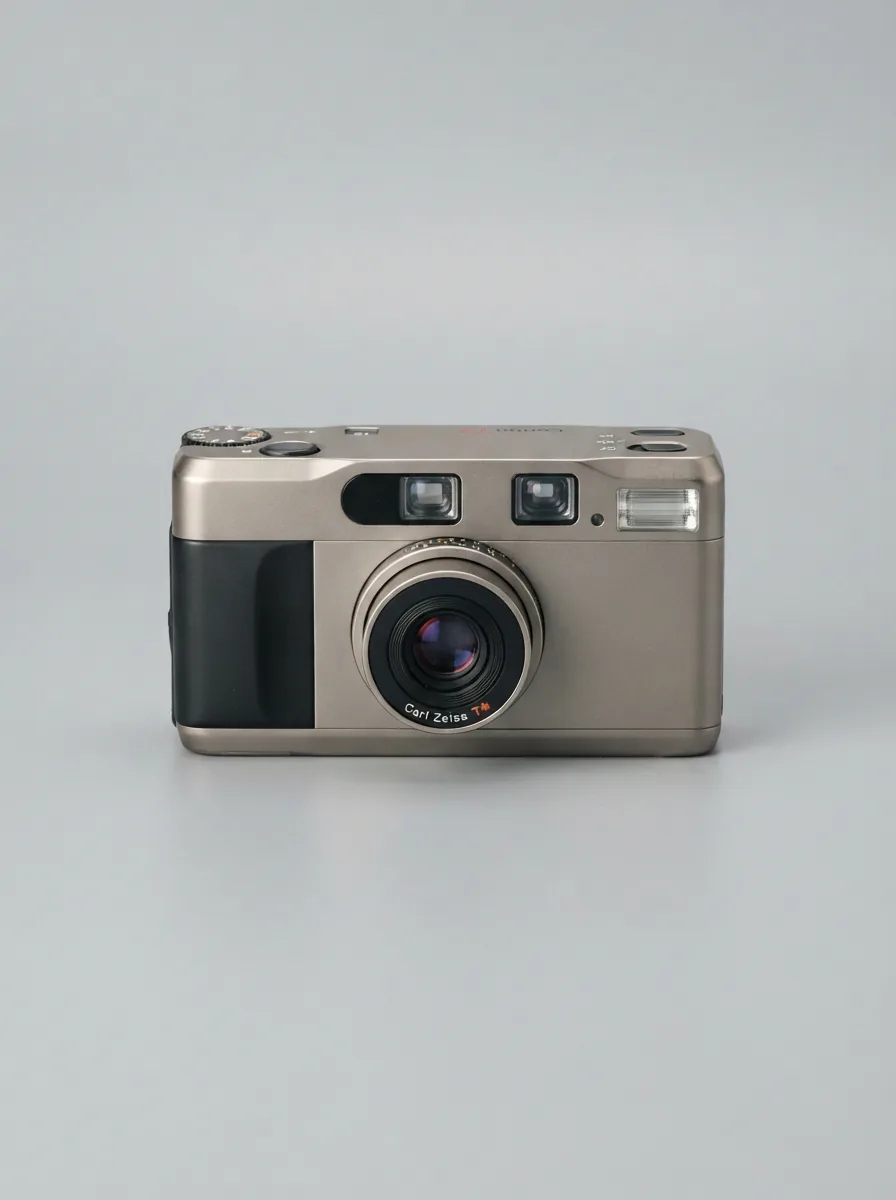
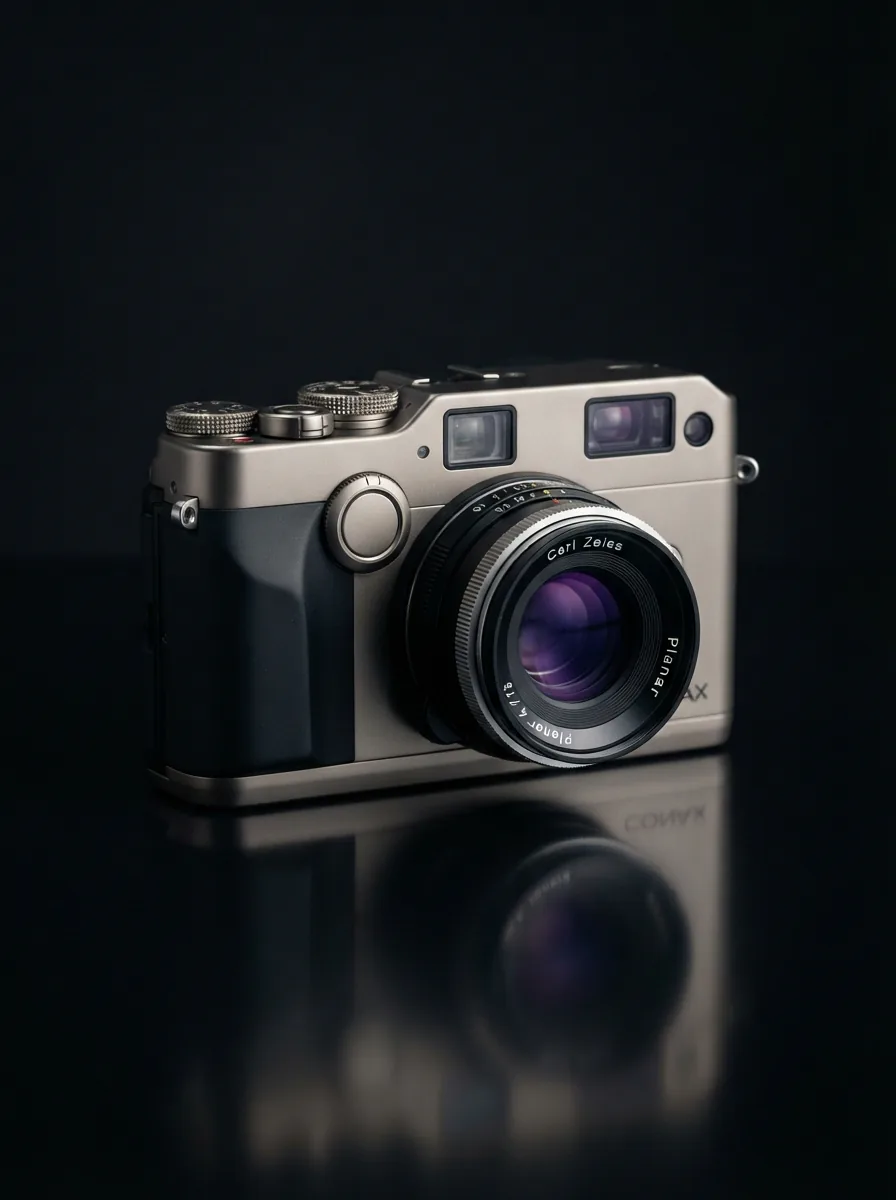
There are cameras you shoot with, and then there are cameras you build a relationship with. The Contax G2 belongs firmly in the second category. Released by Contax in 1996 as the direct and comprehensively improved successor to the G1, this 35mm autofocus rangefinder camera arrived with a precision-machined titanium body, a dual autofocus system unprecedented in any rangefinder design, and access to one of the finest optical families ever assembled — the Carl Zeiss T* G-mount lens lineup. Nearly three decades after its introduction, the G2 continues to command serious attention from film photographers worldwide, and for good reason: it performs with a consistency and precision that very few cameras — analog or digital — have ever matched. Whether you are returning to film photography after years away from it, or you are a seasoned darkroom hand looking to invest in a system that delivers reliably excellent results, this guide gives you everything you need to know about the Contax G2 — what it is, why it matters, how it performs in real-world shooting situations, and exactly what to expect when purchasing one on today’s used market.
Top 5 Most Popular Contax G2 Configurations on the Market Today
Before diving into the camera’s full specifications and performance characteristics, here is a curated list of the five most popular Contax G2 configurations currently available through established resellers. Prices reflect typical ranges seen across major platforms including eBay, Kamerastore, and specialty dealers such as Victory Camera.
1. Contax G2 Camera Body Only (Champagne Titanium)

The standard champagne titanium finish body is the most common and accessible entry point for anyone building a Contax G system. Body-only listings give buyers the freedom to pair their G2 with the specific lens that best suits their shooting style, rather than committing to a bundle that may not match their needs. This is the configuration most often recommended for photographers who already own G-mount glass or who want to acquire lenses selectively over time. Build quality is exceptional, with the titanium chassis offering durability and a distinctive feel that plastic-bodied alternatives simply cannot replicate.
Rating: ⭐⭐⭐⭐⭐ (4.8 / 5)
Price Range: $1,615 – $1,975
2. Contax G2 with Carl Zeiss Planar T* 45mm f/2 Lens

The 45mm Planar T* is widely regarded as one of the greatest standard focal length lenses ever produced for any 35mm film camera, and the pairing of this lens with the G2 body is the single most recommended starting configuration for new G system users. The 45mm perspective is natural, versatile, and well-suited to a wide range of subjects — portraits, street photography, documentary work, travel, and everyday life. The Planar’s optical rendering combines impeccable sharpness with high contrast, accurate color rendition, and smooth background separation when shot wide open at close range. If you are going to own one G2 setup and nothing else, this is it.
Rating: ⭐⭐⭐⭐⭐ (4.9 / 5)
Price Range: $2,169 – $2,599
3. Contax G2 with Three-Lens Kit (Biogon 28mm + Planar 45mm + Sonnar 90mm)

For photographers who want a complete, professional-grade system capable of covering virtually every situation, the three-lens kit is the definitive Contax G2 package. The Biogon 28mm f/2.8 handles wide-angle and environmental coverage with near-zero distortion. The Planar 45mm f/2 handles everyday and general-purpose shooting at its absolute best. The Sonnar 90mm f/2.8 delivers portrait-quality results with the kind of three-dimensional subject separation and resolving power that puts it in the same class as the finest portrait lenses available for any film system. This is the kit that serious photographers invest in and keep for decades.
Rating: ⭐⭐⭐⭐⭐ (5 / 5)
Price Range: $2,799 – $3,799
4. Contax G2 Black Body

The black finish Contax G2 is significantly rarer than the champagne titanium version and is highly coveted by both working photographers and serious collectors. Available in black paint and black chrome finishing options, the black G2 offers identical performance to the standard model while presenting a more discreet, visually commanding exterior. For photographers who value both functional excellence and collector appeal in a single purchase, the black body represents the pinnacle of the G2 lineup. Budget accordingly — the premium over standard champagne examples is consistently substantial.
Rating: ⭐⭐⭐⭐⭐ (4.9 / 5)
Price Range: $2,349 – $4,499
5. Contax G2 with Carl Zeiss Vario-Sonnar 35-70mm f/3.5-5.6 Zoom Lens

The only zoom lens in the Contax G lineup, the Vario-Sonnar 35-70mm f/3.5-5.6 delivers genuine versatility for photographers who prefer a single lens solution for travel, events, or documentary situations where changing lenses is impractical. While it does not match the maximum apertures of the prime lenses in the system, its optical quality reflects the full weight of Carl Zeiss engineering — remarkable sharpness, excellent contrast, and the T* anti-reflection coating that defines the G lineup. The G2’s viewfinder adjusts dynamically as you zoom, showing the exact field of view at every focal length increment, making this combination particularly intuitive to shoot.
Rating: ⭐⭐⭐⭐⭐ (4.7 / 5)
Price Range: $2,495 – $3,449
A Brief History of the Contax G2
To fully appreciate what the Contax G2 represents, it is worth understanding the context in which it was developed. Contax, operating as a brand under Kyocera Corporation, had already established a strong reputation with its professional SLR lineup when it introduced the Contax G1 in 1994. The G1 was a bold departure — a compact, autofocus rangefinder with interchangeable Carl Zeiss lenses, targeting photographers who wanted Leica-level optical quality with the convenience of electronic autofocus. It was genuinely innovative, but it had a critical weakness: its autofocus system relied exclusively on passive phase detection, which performed inconsistently in low light and with certain subject types. User confidence in the system was undermined by missed shots that even careful technique could not reliably prevent.
Kyocera responded with precision. In 1996, the Contax G2 was introduced as a direct upgrade that addressed the G1’s primary limitation without compromising the qualities that made the system compelling in the first place. The titanium body was retained, as was the G-mount lens system, the motorized film advance, and the elegant overall design. What changed was the autofocus system — dramatically. The G2 added an active infrared triangulation system to work alongside the existing passive phase detection, creating a dual-mode focusing architecture that delivered far greater reliability across a wider range of conditions. Shutter speed range was expanded. Continuous shooting speed was increased to 4 frames per second. The viewfinder display was refined. The ISO range was broadened to encompass films rated from 6 to 6400. Every meaningful user complaint about the G1 was addressed in a single successor model.
The G2 remained in production until Kyocera discontinued its entire camera division in 2005, a decision that transformed what was already a desirable camera into a genuine collector’s piece with enduring market value.
Design and Build Quality
The first thing most photographers notice when picking up the Contax G2 is how remarkably solid and deliberate the construction is. The titanium body — available across three distinct finishes — communicates quality through every surface. It is dense without being burdensome, compact without feeling fragile. At 140 x 81 x 46 mm and a weight of 560 grams, it occupies roughly the same dimensional class as a Leica M body, an apt comparison given the philosophical similarities in their design intent.
The finely knurled metal dials click into their detents with a precision that immediately distinguishes the G2 from cameras built to lesser standards. The control layout is genuinely intelligent. The exposure compensation dial — offering a generous +/- 2 EVs of adjustment — sits in an immediately reachable position on the top plate and operates without any locking mechanism that would slow down shooting. The automatic bracketing switch is nested beneath this same dial, reducing visual clutter while keeping the feature accessible to those who need it. The AEL (auto-exposure lock) function is integrated into the On/Off switch, a compact design decision that maximizes the usability of the top plate without overcrowding it.
Ergonomically, the G2 rewards careful attention. The manual focus wheel is positioned directly under the middle finger of the shooting hand, enabling single-handed focus adjustments without breaking grip. A dedicated autofocus button on the rear of the camera rests naturally under the shooter’s thumb, allowing the user to initiate focus independently from the shutter release — a technique favored by photographers who prefer to focus and recompose. This same rear button cycles between single, continuous, and manual focus modes with successive presses.
Aperture control, as with all G-mount lenses, is handled through a traditional ring on the lens barrel, with clearly defined click stops at each full f-stop. The combination of this manual aperture input with the camera’s electronic exposure automation creates a highly practical shooting workflow — set your depth of field requirements with the aperture ring, and let the G2 handle the shutter speed calculation automatically.
The Dual Autofocus System
The Contax G2’s autofocus system is its most technically significant improvement over the G1 and one of its greatest practical strengths. Where the G1 depended entirely on a single passive phase-detection autofocus system that struggled in challenging conditions, the G2 operates a fundamentally different architecture: passive phase detection working in conjunction with an active infrared triangulation module. The two systems operate collaboratively, with the camera deploying whichever combination provides the most accurate focus solution in any given situation.
In practice, this dual-system approach delivers impressive results. Under normal daylight conditions, the phase detection system locks quickly and accurately onto the center of the frame. In reduced light, or when shooting subjects that passive detection struggles to resolve cleanly, the infrared triangulation system provides a secondary reference to confirm or correct the focus calculation. The overall outcome is an autofocus performance that regularly surprises photographers familiar with the G2’s mid-1990s origins — it compares favorably with autofocus systems produced years after the G2’s release.
Autofocus is initiated either by half-pressing the shutter release or by pressing the dedicated rear focus button, with the chosen mode selectable based on the shooter’s preferred workflow. Confirmation is provided through the viewfinder’s LCD display, which shows a centered focus indicator when the subject is in focus and displays the focus distance numerically. Once focus is confirmed, a full press of the shutter fires immediately, without perceptible lag. The continuous autofocus mode, combined with the 4 fps motor drive, makes the G2 a genuinely capable tracking camera for subjects that are moving rather than static.
The Revolutionary Viewfinder
If any single feature illustrates how unconventional the Contax G2’s design philosophy is, it is the electronic viewfinder system. Traditional rangefinder cameras use fixed or switchable frame lines superimposed on a larger optical field to indicate the approximate coverage area of the mounted lens. This approach has its advocates, but it carries inherent limitations: parallax error compensation is approximate at best, the experience of shooting longer lenses through a wide-set rangefinder viewfinder is often compromised, and the view outside the frame lines serves no direct compositional purpose.
The Contax G2 discards this convention entirely. Its viewfinder is electronically coupled to the mounted lens, adjusting its field of view automatically to match the optic installed on the camera. Mount the Biogon 28mm and the viewfinder immediately presents a 28mm perspective. Fit the Sonnar 90mm and the viewfinder tightens to show precisely the 90mm field. Attach the Vario-Sonnar zoom and the viewfinder adjusts in real time as you zoom through the 35mm to 70mm range, showing the exact framing at each focal length without requiring the shooter to consult a separate frame line or estimate coverage. You see exactly what the lens sees, nothing more and nothing less.
The backlit LCD information display at the bottom of the viewfinder frame provides a comprehensive shooting data overlay without cluttering the compositional area. Shutter speed, exposure compensation status, focus distance in manual mode, focus confirmation during autofocus operation, and flash confirmation are all presented clearly. Parallax correction is automatic, adjusting for close-focus offset between the viewfinder axis and the lens axis at shorter working distances. A diopter adjustment accommodates individual vision requirements.
Exposure System and Metering
The G2’s through-the-lens, low-center-weighted metering system reads off the surface of the grey shutter curtain immediately before exposure. It is a fast and reliable metering approach that produces consistently accurate exposures across a wide range of lighting conditions when used with a basic understanding of exposure compensation. The system operates across a shutter speed range of 4 seconds to 1/4000s in manual and aperture-priority modes, with the auto-exposure mode extending the maximum to 1/6000s when necessary — sufficient for shooting wide-open in bright sunlight with most commonly used films.
The camera’s primary shooting mode is aperture-priority auto-exposure. The photographer sets the desired aperture on the lens ring, and the G2 calculates and sets the appropriate shutter speed automatically. Combined with the top-plate exposure compensation dial, this configuration gives the shooter complete practical control over the visual result — depth of field is determined directly via the aperture ring, while the overall exposure accuracy is handled by the camera’s metering intelligence. Photographers who understand how and when to dial in exposure compensation will find the G2 capable of handling virtually any real-world lighting situation effectively.
The ISO range of 6 to 6400 accommodates the full spectrum of available film stocks, from ultra-slow technical emulsions to high-speed black-and-white films for low-light situations. Film DX coding is read automatically from compatible canisters.
The Carl Zeiss T* Lens Ecosystem
No discussion of the Contax G2 can be complete without a thorough examination of the lenses it was designed to support. The Carl Zeiss T* G-mount lens system is one of the most consistently praised optical lineups in the history of 35mm photography, and this is a reputation earned through practical performance rather than marketing positioning.
The system comprises seven lenses in total — six prime focal lengths and one zoom. The range runs from the specialist ultra-wide Hologon 16mm f/8 through the Biogon 21mm f/2.8, the Biogon 28mm f/2.8, the Planar 35mm f/2, the benchmark Planar 45mm f/2, and the Sonnar 90mm f/2.8, with the Vario-Sonnar 35-70mm f/3.5-5.6 completing the lineup. Every lens in this system carries the T* anti-reflection coating that reduces flare and ghosting while maximizing contrast and color accuracy.
The 45mm Planar occupied the position of world’s highest-rated standard focal length lens by certain major photographic publications for a considerable period — a distinction it earned through impeccable resolution, zero discernible distortion, high micro-contrast, and an overall rendering quality that produces photographs with a clarity and dimensionality that distinctly Zeiss in character. The 28mm Biogon is a standout for documentary and architectural work, delivering extraordinary sharpness to the edges of the frame with distortion so low it is essentially imperceptible. The 90mm Sonnar produces portraits with a level of subject isolation, sharpness, and three-dimensional rendering that rivals the finest portrait lenses made for any camera system at any price point.
The concise, focused nature of the G-mount lineup is itself a practical advantage. With only seven lenses to choose from, every option represents a deliberate and masterfully executed design choice. There is no weak link, no budget option included to broaden the catalog. Every lens in the system is the best available choice for its focal length within the rangefinder format.
Manual Focus Capabilities
In the interest of balanced assessment, the G2’s manual focus implementation is its most frequently noted limitation, and the criticism is not without merit. Manual focus is controlled through a small wheel on the front of the camera body, with feedback provided via the LCD scale in the viewfinder rather than through a traditional optical rangefinder patch or a through-the-lens focusing screen. This creates what is functionally a digital scale-focusing system: rotating the wheel moves the focus point while the display shows the corresponding focus distance.
For photographers accustomed to the tactile confidence of a classic rangefinder coincidence patch or an SLR focusing screen, this system feels indirect. However, for specific practical applications — zone focusing for street photography, tripod-based long-exposure work, or shooting at pre-calculated hyperfocal distances — the manual focus system is genuinely usable and delivers accurate results when the shooter applies technique deliberately. The broader reality is that the G2’s autofocus is reliable enough that manual focus is rarely the better choice in most real-world situations.
Buying Guide: What to Look For
When acquiring a used Contax G2, several specific condition points deserve careful evaluation before any purchase commitment.
LCD bleed is the most commonly cited age-related issue with G2 bodies. The liquid crystal material in both the viewfinder information display and the top-plate display can, over time, bleed beyond its intended boundaries, obscuring portions of the readout. Mild bleed may not interfere with shooting, but significant bleed makes the information display unreliable. Confirm LCD condition explicitly, either through high-resolution photographs of the displays or by purchasing from a dealer who provides verified condition documentation.
Autofocus reliability should be tested across multiple distances and lighting conditions. A G2 with inconsistent autofocus behavior may benefit from a professional CLA (clean, lubricate, and adjust) service, which restores the focusing system’s calibration and improves reliability. The cost of a CLA should factor into your evaluation of a given listing’s asking price relative to its stated condition.
Shutter consistency across all speed settings is worth verifying. Battery compartment integrity is also important — the G2 operates on a single CR2 lithium battery, and any evidence of past battery leakage or corrosion at the contacts should be treated as a significant concern. Reputable specialist dealers typically inspect and document these points as part of their condition assessment process, which is one of the clearer arguments for paying a modest premium through an established seller rather than sourcing through private listings.
Pricing and Where to Buy
The current used market for Contax G2 cameras reflects both its enduring performance reputation and the broader increase in demand for premium film cameras that has characterized the past decade. Body-only examples in good to excellent used condition currently trade in the approximate range of $1,615 to $1,975, with pricing variance tied to cosmetic condition, LCD integrity, and whether the listing includes any accessories. The Kamerastore listing price of $1,853 for a certified body-only example is representative of the mid-market rate from a reputable specialist dealer.
Camera with 45mm Planar configurations typically range from $2,169 to $2,599 for solid used examples. Three-lens kits (28/45/90mm) in good condition list from approximately $2,799 to $3,799, while top-mint examples with original packaging and flash push toward the upper end of that range and beyond. Black finish bodies begin around $2,349 for standard used condition and climb to $4,499 or more for near-mint examples. Comprehensive multi-lens sets in original packaging from collector-grade sources can reach $7,000 to $10,000.
For buyers who prioritize confidence in what they are receiving, purchasing through established specialist dealers with documented condition ratings, return policies, and warranty coverage is consistently the most practical approach. Dealers including Kamerastore, Victory Camera, and comparable specialty resellers provide the level of verification and recourse that justifies a premium over private or auction-format listings.
Verdict
The Contax G2 is, without qualification, one of the most accomplished 35mm film cameras ever built, and its continued relevance on the market nearly three decades after its release is the most honest measure of that achievement. Its titanium construction, dual autofocus architecture, dynamic lens-coupled viewfinder, reliable through-the-lens metering, and access to the Carl Zeiss T* G-mount optical system combine to create a camera that performs beyond its era and competes meaningfully with the best tools available in film photography today.
Its limitations are real but manageable: the manual focus experience is imprecise compared to traditional rangefinders, the LCD displays are susceptible to age-related degradation, and acquisition cost is substantial at current market rates. These are practical considerations to plan for, not fundamental barriers. For the photographer committed to the craft of film shooting — who values optical excellence, dependable performance under real conditions, and the experience of working with a machine built to the highest standard — the Contax G2 represents one of the most justified investments in analog photography available anywhere on today’s market.